



Bayou Artist | Patrick Crawford
ARTICLE BY APRIL C DOUGHTY
PHOTOGRAPHY BYKELLY MOORE CLARK
After a lifetime spent working with metal, Patrick Crawford has found a new creative rhythm in woodworking. In retirement, he’s trading deadlines for craftsmanship, turning Louisiana wood into one of a kind pieces and finding plenty of joy along the way.
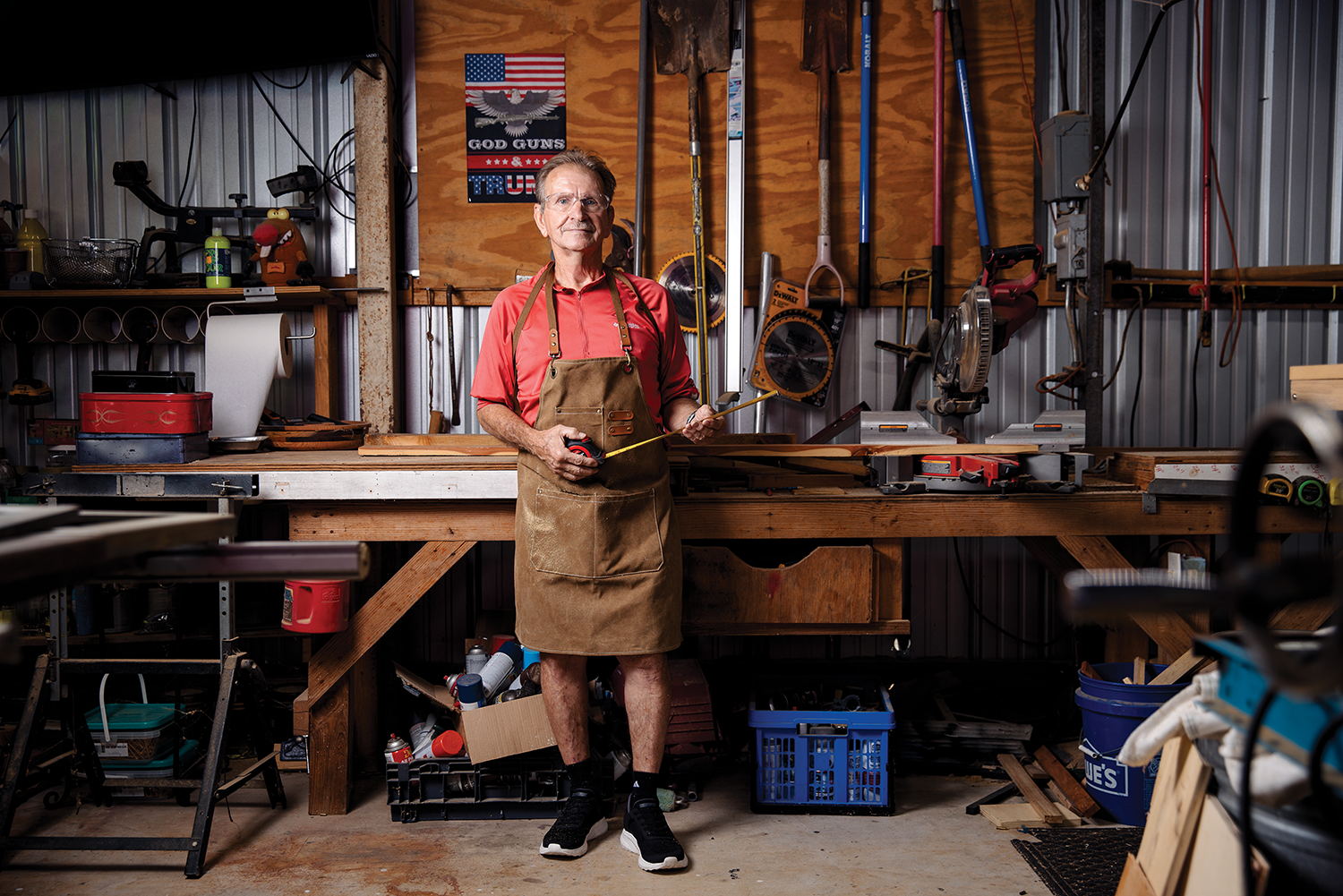
In his younger years, Patrick Crawford was a driven business man whose work in welding and metal fabrication was characterized by sparks and speed. Now that he’s in his 70s and retired, Crawford has replaced the fast-paced life of deadlines and quotas with the slow and deliberate pace of woodworking.
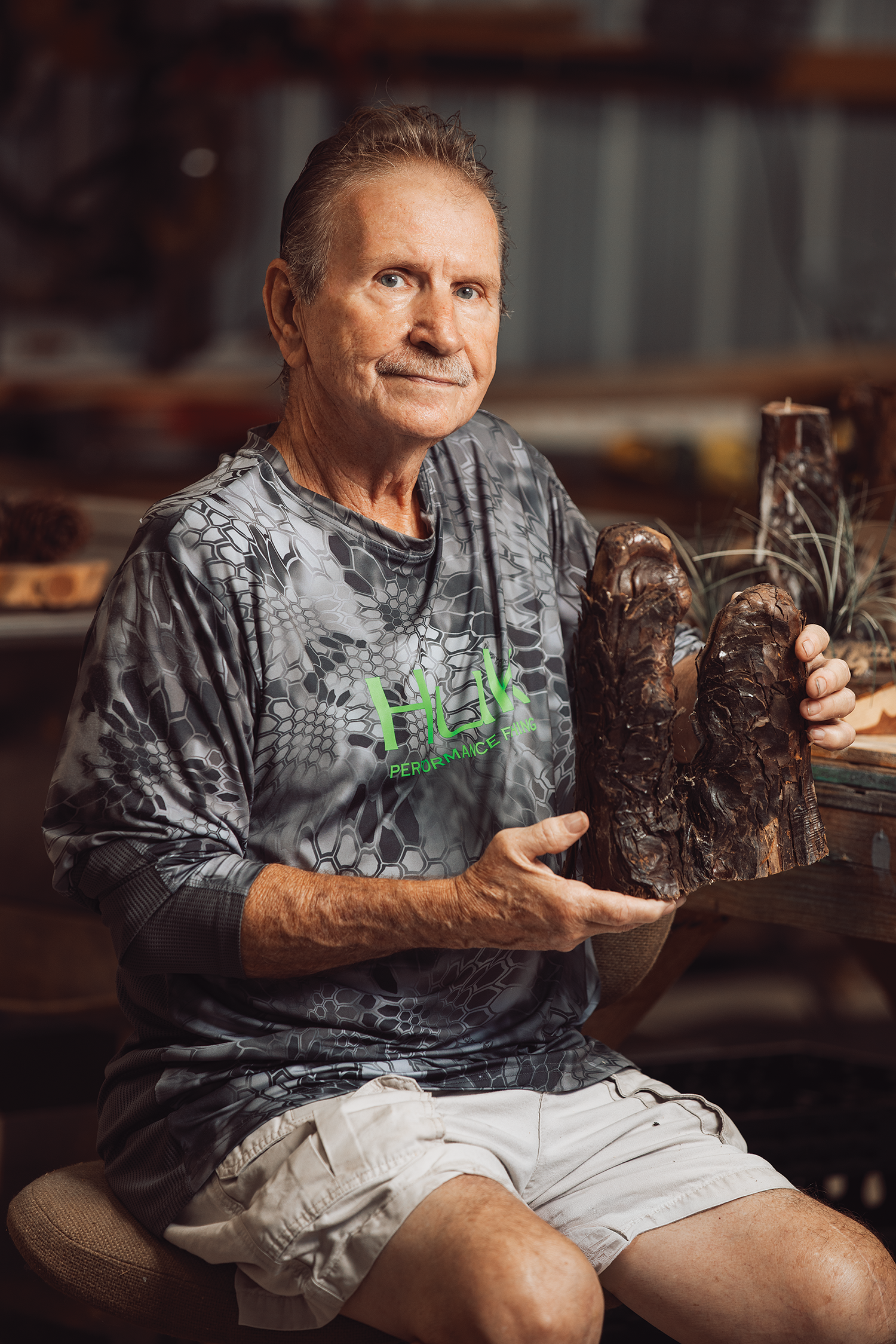
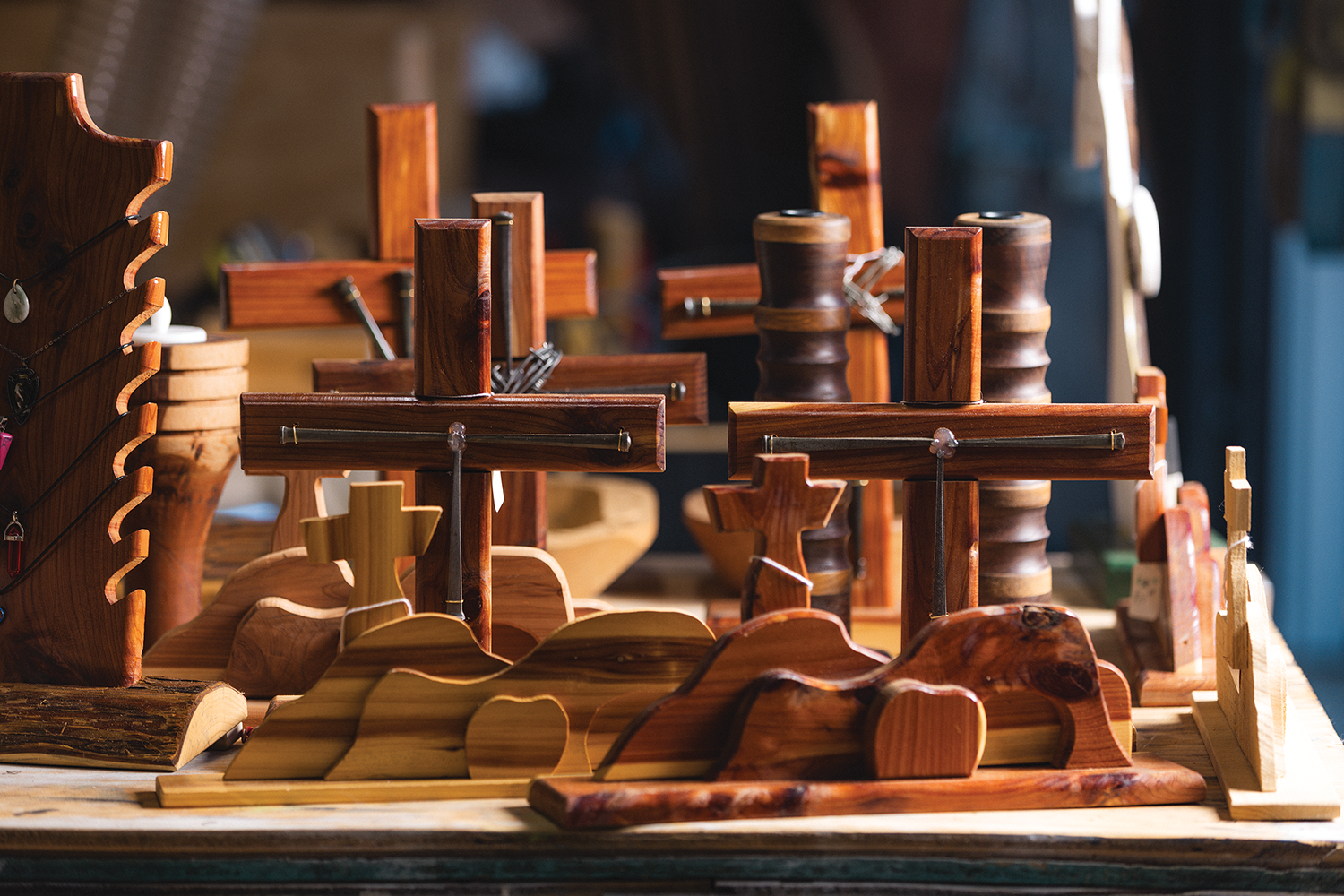
Six years into his retirement, Crawford has settled into his hobby, making bowls, candle holders, Christian-themed items, butcher blocks, picture frames, wildlife scenes, furniture, and more. He’s even built deer stands and some functional wishing wells for the yard. He said he can build “pretty much anything you want” with an idea or picture to get him started. He’s no stranger to hard work, and said, “I’ve always liked a challenge, and if it’s something different, something I’ve never done, I’m not going to stop till I get it done. And then once I get it done, I’ll say, ‘Well, what’s next?’”
After growing up in Bastrop and graduating from Bastrop High School, Crawford briefly attended Hinds Junior College in Jackson, Mississippi, where he primarily studied air conditioning. Before he could finish his studies, he was drawn into working on offshore rigs on the Mississippi River. Soon after, he affiliated with a local pipefitter’s union and spent many of his younger years traveling and working as an x-ray welder.
Crawford eventually settled down in West Monroe and invested the remainder of his career in growing his business, Industrial Metal Fabrication, Inc. (IMF), which continues under the leadership of his stepson John Ortega. Crawford’s work at IMF demanded precision, dedication, and long hours, but those hours paid off.
As he approached retirement, Crawford could have planned for a life of leisure. When he stopped working, he could have put down his tools altogether and embraced a quiet life of doing nothing. Instead, Crawford took his doctor’s advice to stay active and find ways to keep his mind and body engaged. He saw retirement as an opportunity to find a new purpose and to pick up tools of a different kind.
As retirement grew near, Crawford started gradually collecting the tools and equipment he would need for the woodworking hobby he’d always had an appreciation for.
One of his favorite tools is a 32-inch sawmill. He said, “Sawing is hard to explain. It’s very relaxing. You put that log up there, and you fire that machine up and that blade’s doing a high RPM, and when that blade hits that wood and you’re sawing, it’s just relaxing.” Watching it is one of the things he loves to have other people, including his grandkids, to experience.
Overall, becoming a woodworker in retirement has been almost like returning to a past life for him. Crawford’s dad was a union carpenter and built houses for a living, so Crawford had memories of working alongside his dad as a teenager in the summers doing carpentry and woodworking. As a young man, life took Crawford in a different direction, but the appeal of woodworking never wore off. As an adult, Crawford was reminded of how much he enjoyed working with wood while helping his younger brother Kenny on projects. Kenny followed in his father’s footsteps, working in carpentry, home remodeling, and woodworking. “I helped him off and on,” Crawford said, “and just got the knack for working with wood. I really love it.”
Crawford attributes his love for wood and woodworking to his dad and brother Kenny, but he believes at least part of his talent for it also comes from his mom’s side of the family, specifically his grandfather Clark. “That guy was as close to a genius as anybody I’ve ever seen,” Crawford said, “and he could take any problem, solve anything, build anything. I guess we got a little bit of that in our DNA because my brothers are the same way.” In fact, building things is truly a generational way of life for Crawford, whose daughter Amanda and her husband have their own sawmill as well and are building a house on property near Bastrop from trees on their own property. Their goal is to buy as little as possible and build their home the old-fashioned way, according to Crawford, who spoke of their decision with pride.
Today, Crawford approaches the craft of woodworking without the deadlines, production schedules, or pressures that once accompanied his work with metal. When he was still working in metal fabrication, he was meeting with hundreds of people a week, so going from that to what he called “a dead stop” took some adjustment. Crawford has now adapted to the slower, self-directed pace, but the first year was hard. “I didn’t know what to do,” he said.
Now Crawford enjoys the slower pace and the calm that comes with it. He takes time to savor his coffee in the mornings and time to think about his projects, plan them, and execute them on his own schedule. The process of turning a piece of wood into something useful or beautiful has become a source of relaxation rather than stress. What began as a way to simply keep moving and restore his sense of purpose has become something much more meaningful.
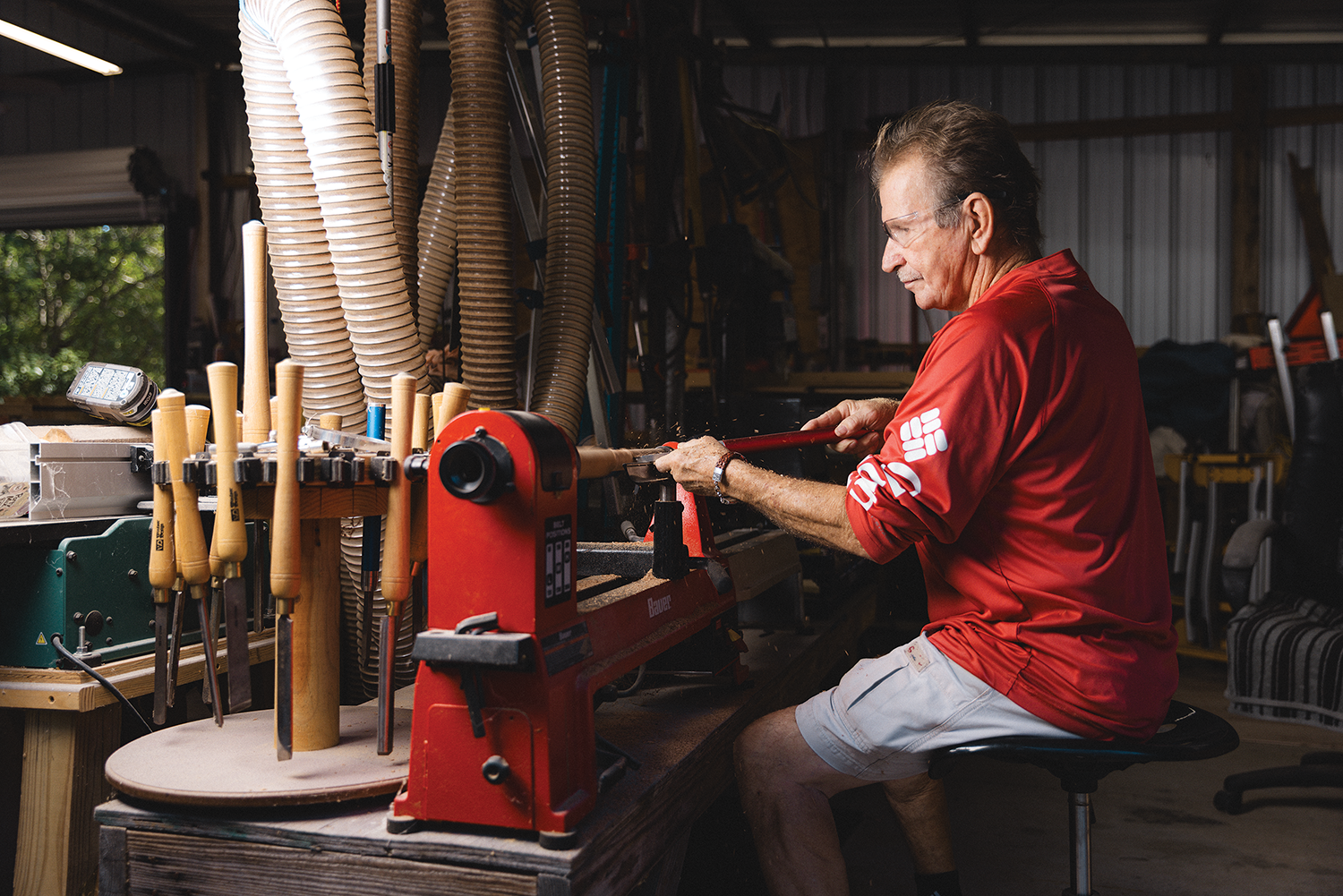
In his woodworking shop, he can take his time, work with his hands, and enjoy the process without worrying about what comes next. After a lifetime of working toward finished products with the customer always in mind, he’s discovered the pleasure of simply being present while making things he chooses at a pace that suits him. In his workshop, the process itself has now become the reward.
These days, Crawford isn’t woodworking to make a living. He said, “If you’re doing it for money, you might as well quit because nobody could ever pay for the time and effort and knowledge that you put into every project, and you’re not going to get it, so you have to go into it with a mindset that if you sell it, that’s great, but if you don’t, that’s great too.” Crawford said he and his wife Ruth, who is a glass artist, gift a lot of things they don’t sell, but they’ve left behind the part of their lives where the proverb that time is money held true.
Now Crawford is creating with wood because it makes him happy. “‘It’s really slowed me down,” he said. “You can actually take time to breathe and enjoy what you’re doing.” One of the most important things Crawford has learned from woodworking is patience. “I was pretty highstrung as a young man,” he said, “and in metal work, it’s not an easy trade. You’re always pulling, snatching, jerking metal, and everything’s kind of wide open in the metal business.”
Working with wood is the opposite in many ways. The medium itself is less forgiving and demands more care. Although Crawford sometimes uses metal and wood together and blends the two well, he said, “With wood, you have to be a little bit more precise because once you cut it, that’s it. You can’t go back. It’s done.” Metal, on the other hand, is more malleable. Crawford said you can make a mistake with metal, and there are usually multiple ways to fix it. With wood, a mistake often means scrapping a project completely and starting over. “So I don’t mind taking my time to get it right,” he said. “And then, I know you’re not supposed to pat yourself on the back, but it really feels good when you do a good job on the end product.” While the process itself is definitely its own reward, it can also be rewarding to use, hold, or admire something you made with your own two hands.
It’s equally rewarding to see other people admire the hard work that goes into a piece. Together, Crawford and his wife Ruth have turned their shared love of making things into a reason to travel. They regularly visit arts and crafts shows, bringing their creations along for others to enjoy and to ensure their home doesn’t become overrun with their handiwork. Crawford often makes frames and items to help Ruth display her glass work, and the two of them share the spotlight at shows. According to Crawford, women tend to appreciate his butcher blocks, bowls, frames, and candle holders most, whereas men tend to appreciate his outdoor scenes, which are reminiscent of the Louisiana outdoors.
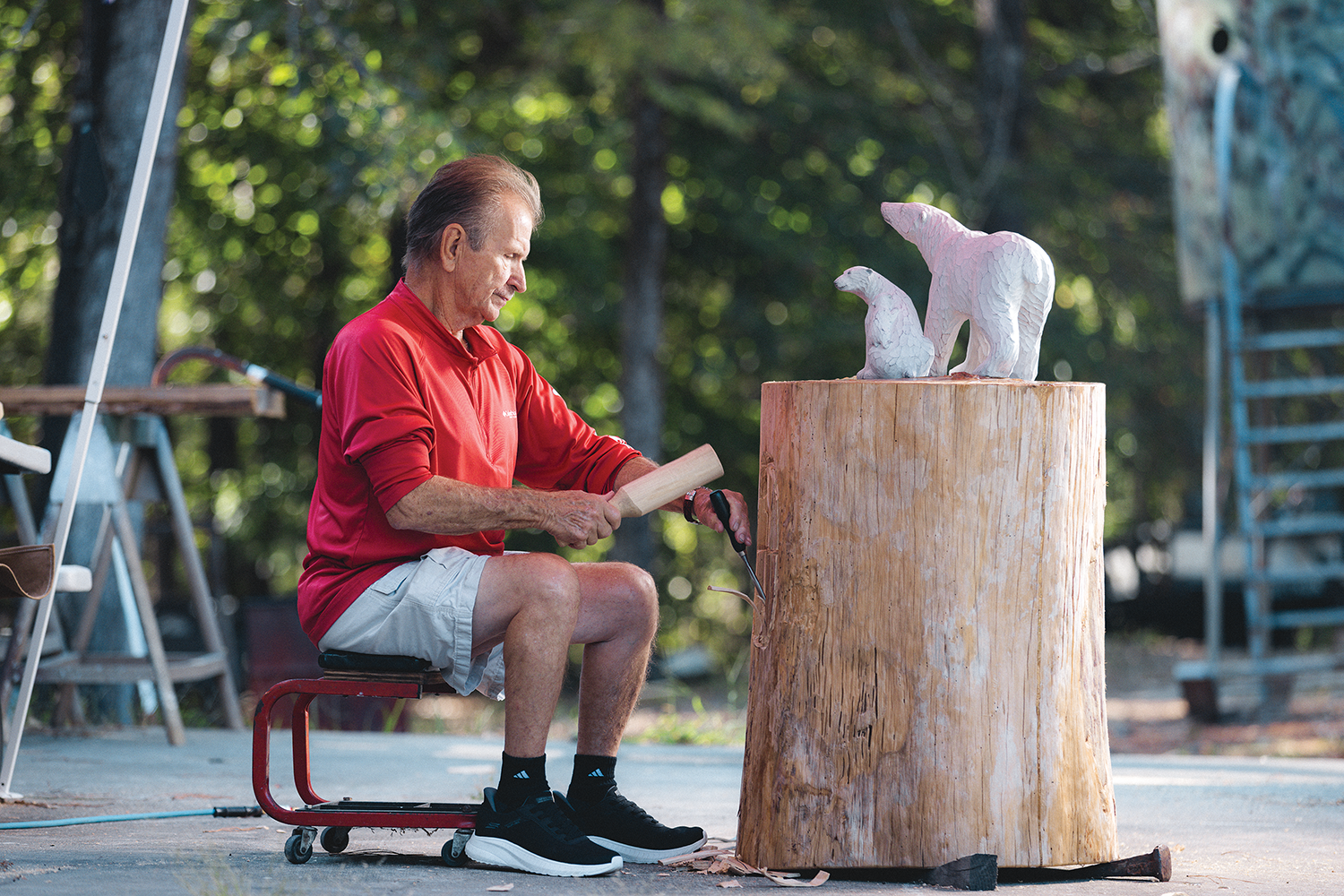
Crawford considers himself a Louisiana artist through and through. “Being born and raised here,” he said, “I’m not always proud of Louisiana, especially our politics, but as far as the land and the culture, I love it, and I’ve been in and out of every bayou, every creek, every spot of woods within a 200 or 300 mile radius.” These experiences now serve as the perfect inspiration for his wildlife scenes. Although he’s thought of moving away more than once, he admitted that Louisiana has a certain magnetic pull. “I guess that’s the reason they call it the Sportsman’s Paradise,” he said, “because we really have it all. We’re lucky to have everything here.”
The source of Crawford’s wood projects also makes them uniquely Louisianan. Given that Crawford owns several acres of land and owns his own sawmill, wood is a readily available and sustainable resource. Crawford has access to mixed hardwood forests with a variety of trees, including oak, pine, cherry, beech, cedar, cypress, fir, and cottonwood. He said he rarely has need to down a tree himself because adverse weather events, such a tornadoes, ice storms, and even hurricanes leave plenty of downed trees in their wake. In the aftermath, Crawford does his best to make sure these fallen trees don’t go to waste.
In terms of process, Crawford typically starts with sketches. He took drafting and plane geometry courses in school, which he said still come in handy. The amount of math involved in the work he does also keeps his brain working. Some projects require more detailed drawings and more drafts than others. In addition, some projects, such as the wildlife scenes, tend to develop more organically after the initial idea is down on paper, but Crawford said he never starts a project without first at least sketching it out. Once he gets a solid sketch, “a good game plan,” and a material list, he said, “Then when you start on it, it just pretty much kind of falls together.”
For both Crawford and his wife, their creative pursuits have become more than hobbies. They’re a way to stay busy, stay curious and continue making meaningful things that bring them together. Crawford said, “I’m lucky to be as healthy as I am at 74. I have good days and bad days, but as long as I can move, I’m gonna do something worthwhile every day.”
For Crawford, retirement hasn’t meant slowing down so much as changing pace. The urgency of the working world has given way to the natural rhythm of woodworking, where the finished piece matters, but the joy found in the woodworking process matters even more. Crawford said, most importantly, that he “could not have achieved all this without the grace of God.”