



Strength From The Sea
by Guy Miller, Vice Chair Emeritus, Chennault Aviation and Military Museum
I’ll let you in on a little “behind the scenes” information. If you read my articles regularly you know I’ve been writing them for many years. If I could freely write about anything related to current or historical aviation, space or the military I could compose a new article every day for the rest of my life and not repeat any topics. But that is not how this works.
The editor of this magazine establishes a couple of themes that she associates with each month. I do my best to write something related to one of those themes. If I’m struggling with doing so, I search for something to write about that relates to the month itself.
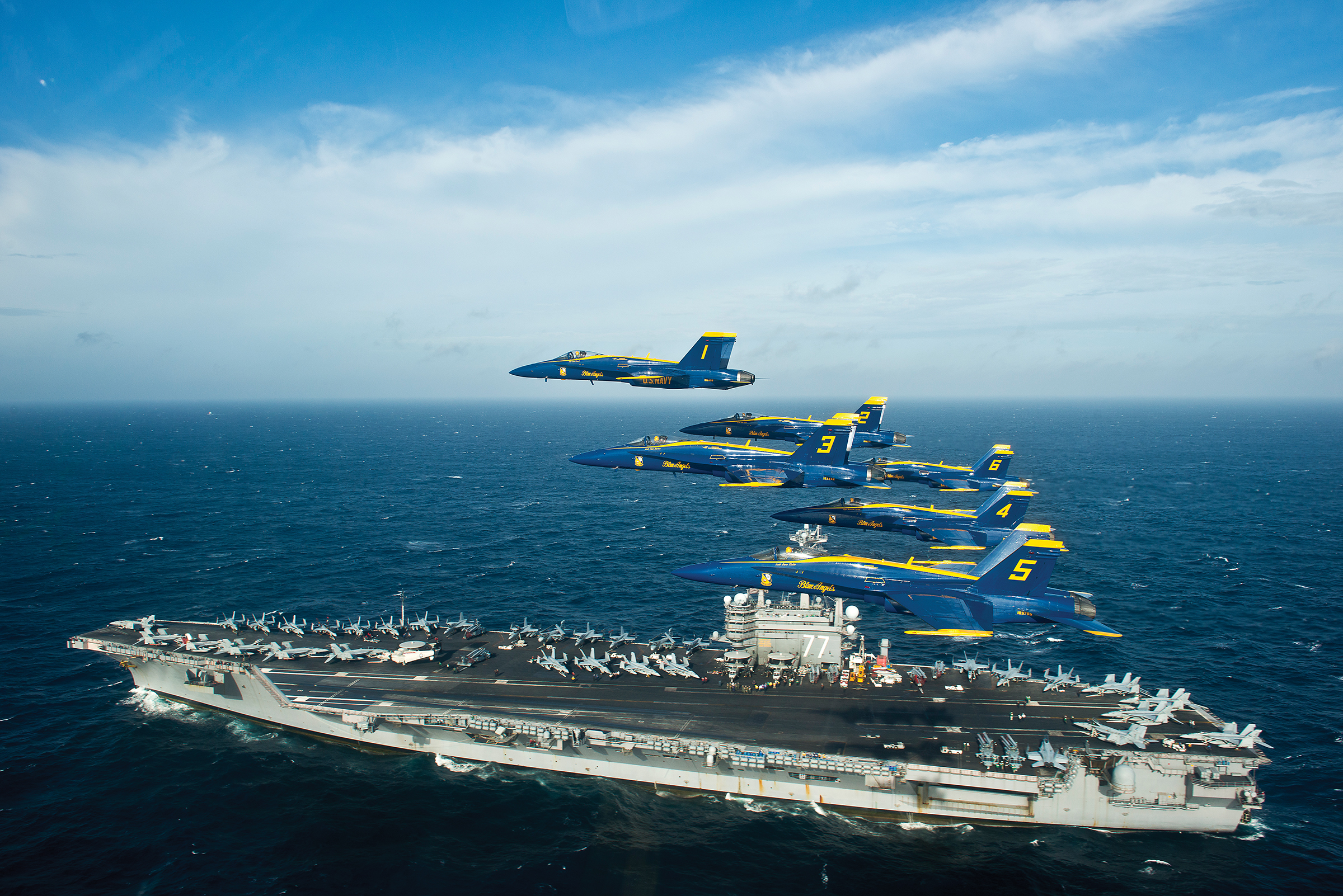
As I reviewed my previous October articles and pondered what new topic I can write about for this current issue I suddenly heard the sound of freedom. From where I’m presently sitting I can hear the unmistakable roar of multiple jet engines on afterburner. I know six beautiful blue F/A-18 E and F Super Hornets are headed into the sky.
My wife and I have lived in Monroe for longer than anywhere else in my adult career or our respective parents’ carriers when growing up. We love Monroe, the people of NE Louisiana and the local culture. But with the flexibility of retirement, right now I am sitting near the waters of Pensacola Bay and the US Navy Flight Demonstration team has just taken off for another weekly practice of their full air show. Super Hornets do make a lot of noise- especially when they are right overhead!- but hearing them never fails to bring a thrill of patriotism. Watching them never grows old.
The US Navy, and to a lesser degree the US Marines, own and fly aircraft because they have one capability and mission that the US Air Force cannot perform. Naval Aviation projects sustained US and allied power, protects the free use of the seas and supports related combat operations with its capability for the rapid response launch and recover air assets from carriers whose range is limited only by the extent of the oceans. I love and respect the US Air Force as the prime aviation force of our Nation but USAF pilots and their planes are not capable of landing on carriers or performing some critical missions with the same flexibility and responsiveness as carrier aircraft.
The United States by far maintains the world’s greatest concentration of carrier-based air power. It’s not even close. The US Navy currently has 20 aircraft carriers (11 for fixed wing and 9 for helicopters and vertical take-off aircraft. The nations with the next nighest number of carriers are France and Japan with four aircraft carriers each- 1 fixed, 3 helicopter and 4 helicopter respectively. China has three (2 and 1) and the remaining ten nations that own carriers have only one or two of some kind.
Our carrier-based air power capability more than almost anything else put us on the winning side of the War in the Pacific. It now offers both strategic and tactical fast and concentrated response to help deter subsequent major conventional conflicts and provides an unmatched humanitarian aid capability after natural or man-made disasters.
Although nations such as the United Kingdom and Japan began experimenting with carrier aviation earlier then the United States, the US Navy embraced aviation from almost the moment the Wright Brothers landed their first aircraft at Kitty Hawk. The Navy’s initial research included the development of seaplanes, seaplane tenders and seaplane launch and recovery capabilities on capital ships. The need for dedicated aircraft carriers and aircraft designed for carrier use became obvious during World War I and in 1920 the Navy began conversion of the collier USS Jupiter (a ship designed to carry coal) into its first test bed aircraft carrier. Because of the conversion, the ship was renamed the USS Langley in honor of Samuel Langley, an American aviation pioneer whose experiments included catapult-launched aircraft.
The Washington Naval Treaty negotiated in 1921 slowed things down for naval aviation experimentation as it was meant to limit the construction of warships. But the final agreement signed by the major world powers in 1922 had an exemption for experimental aircraft carriers that were in existence or under construction as of November 12, 1921. Accordingly the Langley was recommissioned early in 1922.
On October 17, 1922, with the Langley anchored and stationary in York River, Virginia, Lieutenant Commander Virgil C. Griffin made the very first takeoff from the carrier in a Vought VE-7SF. Nine days later on October 26, the Langley was underway at sea and Lieutenant Commander Godfrey de Courcelles Chevalier made the first US carrier landing in an Aeromarine 39B. The first use of the Langley’s catapult for an aircraft launch was on November 18 when the Langley’s executive officer, Commander Kenneth Whiting, catapulted from a carrier’s deck in a Naval Aircraft Factory PT airplane.
Those first flights in October, 1922 brought us to the unbelievable Naval Aviation capabilities that we now have a century later. Some of the history in between can be discovered at the Chennault Museum.
So here’s a happy “anniversary” to Naval Aviation and to the US Navy as a whole, have a wonderful 248th birthday on October 13th. Thank you for reminding me of the dedication your men and women have to our country every time I hear those magnificent Blue Angel F-18s take to the sky.