



Proper Pruning
Happy New Year! I have to start on a low note. The Northeast Louisiana Master Gardeners’ January seminar is canceled. As of this writing, the state is back in a modified Phase 2, and it doesn’t make sense to advertise and go all out if only a very limited number of you would be able to attend in person. And, frankly, the virtual attendance option wasn’t getting a great response. We will try to have P. Allen Smith at some point later in 2021. In the meantime, check out The Gardens of Somerset page on Facebook and see the exciting new facility Allen and his team are installing in Sterlington! Also follow the Northeast Louisiana Master Gardeners on Facebook for updates on the seminar and other events.
Onward and upward….
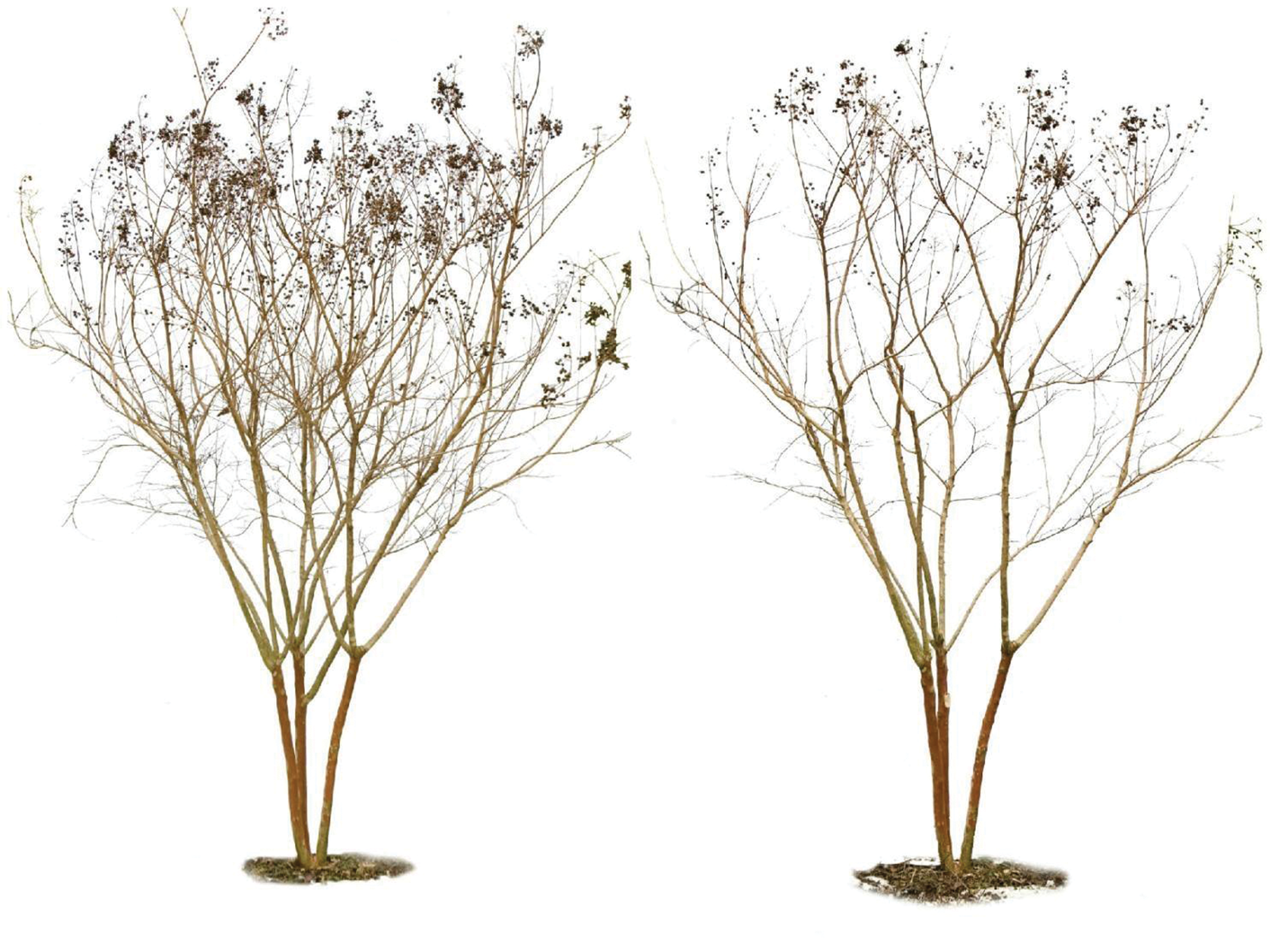
Time now for my annual pruning epistle. Pruning is the singular horticultural topic that either strikes fear into the hearts of home gardeners or, in the case of those with crepe myrtles/crape myrtles, emboldens weekend warriors as well as professionals who should know better to do nonsensical, horrific things. “Crepe murder,” the phrase coined by the Grumpy Gardener of Southern Living Magazine for the senseless decapitation of crepe myrtle trees, continues in our area with relentless abandon. It seems the more we advise that this technique not be practiced, the more it happens. Truthfully, there is some horticultural basis for “crepe murder.” A technique called pollarding, draconian if you ask me, is the removal of the upper trunk and branches of a tree. Put simply, pollarding is decapitating a tree. For reasons explained if you keep reading, copious numbers of lateral branches grow out when your crepes are decapitated. Some trees tolerate the practice better than others. While it is true that crepes flower on new growth, it’s important to remember that crepe myrtles are trees and trees are long term investments. Over time, repeatedly decapitating crepe myrtles stresses them. Remember, trees are living things. They are made of cells and tissues just like we are. When they lose limbs, they have to spend energy and other resources like carbon and nutrients to replace them in addition to energy and resources spent on producing flowers. Like it or not, plants produce flowers for reproduction. We just happen to benefit from the process. These lateral branches are also going to be much weaker than branches allowed to develop otherwise. Stressed crepes are going to be more susceptible to insect pests, too. Crepe myrtle bark scale (CMBS) has been rampant in our area, as evidenced by the black sooty mold colonizing the honeydew droplets on branches and trunks of crepes in many neighborhoods. More often than not, crepes infested with CMBS have also been decapitated or pollarded at some point. Stop it!
Don’t be afraid to prune. But, also prune for a reason and not just to be pruning.
It should never be a fearsome task. But, it isn’t a job to be entered into without doing a little homework first. Think of it as giving your tree or shrub a haircut. Remember going to the barbershop, or beauty shop, for a haircut when you were a kid? Now, you’re the one with the pair of scissors!
Keep these things in mind.
• You’re not going to kill your tree or shrub. The plant will replace what you cut away.
• You don’t need the most expensive tools and equipment on the market. Less expensive tools are available that work just as well.
Pruning is the removal of selected branches from a tree or shrub. Pruning any tree or shrub has four objectives: 1) to encourage new growth, 2) to open the canopy to maximize sunlight penetration to the center of the plant, 3) to open the canopy to maximize air circulation so fungal pathogens are more likely to pass through without infecting the plant, and 4) to control the overall size of the tree or shrub while maintaining a natural appearance. NOTE: shaping shrubs to look like boxes or spheres is really not pruning. Ultimately, the result of this practice will be a stressed, declining plant.
There are two types of pruning cuts: heading cuts and thinning cuts. Heading cuts remove a branch’s terminal or apical bud (the bud at the very tip of the branch). This encourages lateral buds to expand and grow. That is, the branch gets bushy. The branch will continue to elongate as long as the terminal bud is present. This is the principle of apical dominance. Having numerous lateral branches instead of fewer main branches will render fruit trees more productive and ornamentals with a more filled out appearance. Thinning cuts remove entire branches from the tree or shrub. When removing a branch from the main trunk of a tree, always leave the branch collar on the tree. The branch collar is a swollen area on the lower side of the branch’s point of attachment to the main stem or trunk. The branch collar produces callus tissue that will seal the pruning wound. Remember the “four Ds:” dead, diseased, damaged, and decayed. Branches falling into any of these categories should be removed first. Next, look for branches that are crossing and rubbing together. Choose one branch to keep and get rid of the other one. Branches growing back into the canopy should be removed. Water sprouts are vegetative branches growing straight up and will only ever produce leaves. They won’t produce flowers and fruit, and they zap energy from other potentially more productive branches. So, water sprouts should always be removed.
Always remember, woody perennials, whether growing for fruit or ornamental purposes, should be pruned so they harvest sunlight. Think of leaves as solar panels harvesting sunlight and converting that energy into other forms of useful energy the plant uses. Thin the canopy to allow maximum light penetration into the canopy. A crowded canopy means light can’t penetrate to interior leaves. Interior foliage will eventually be lost and other problems could develop. Thinning the canopy also allows good air circulation. Fungal spores, which are ubiquitous, will be more apt to blow right through an open canopy with good air circulation than in a closed canopy. This is especially important with certain rust fungi that colonize two host species in order to complete one cycle of reproduction.
Heavy pruning should be done during our winter months when deciduous trees and shrubs are metabolically dormant. They aren’t actively pulling water and nutrients from the soil as much as during summer, and their photosynthetic mechanisms, housed in leaves, are gone. Roots, however, are still growing, and it’s an easily overlooked point because the root system is out of sight and out of mind. This is primarily why winter is the optimum time to plant woody perennials, too. Very light pruning can be done in summer but this should be done only to maintain size or overall shape; no more than a limb or two.
Have a reason to prune and don’t stress your trees and shrubs. Proper pruning will pay dividends years down the road. Here in the ArkLaMiss, the practice of pollarding trees in ornamental landscapes should be relegated to history. Let’s make “crepe murder” a thing of the past!
For advice on how to make your garden thrive, click on the Louisiana Living link under News at www.myarklamiss.com and submit your questions. I’ll answer them every Tuesday on Louisiana Living!