



In the Garden with Kerry Heafner:
Searching for North Louisiana’s Lost Apple
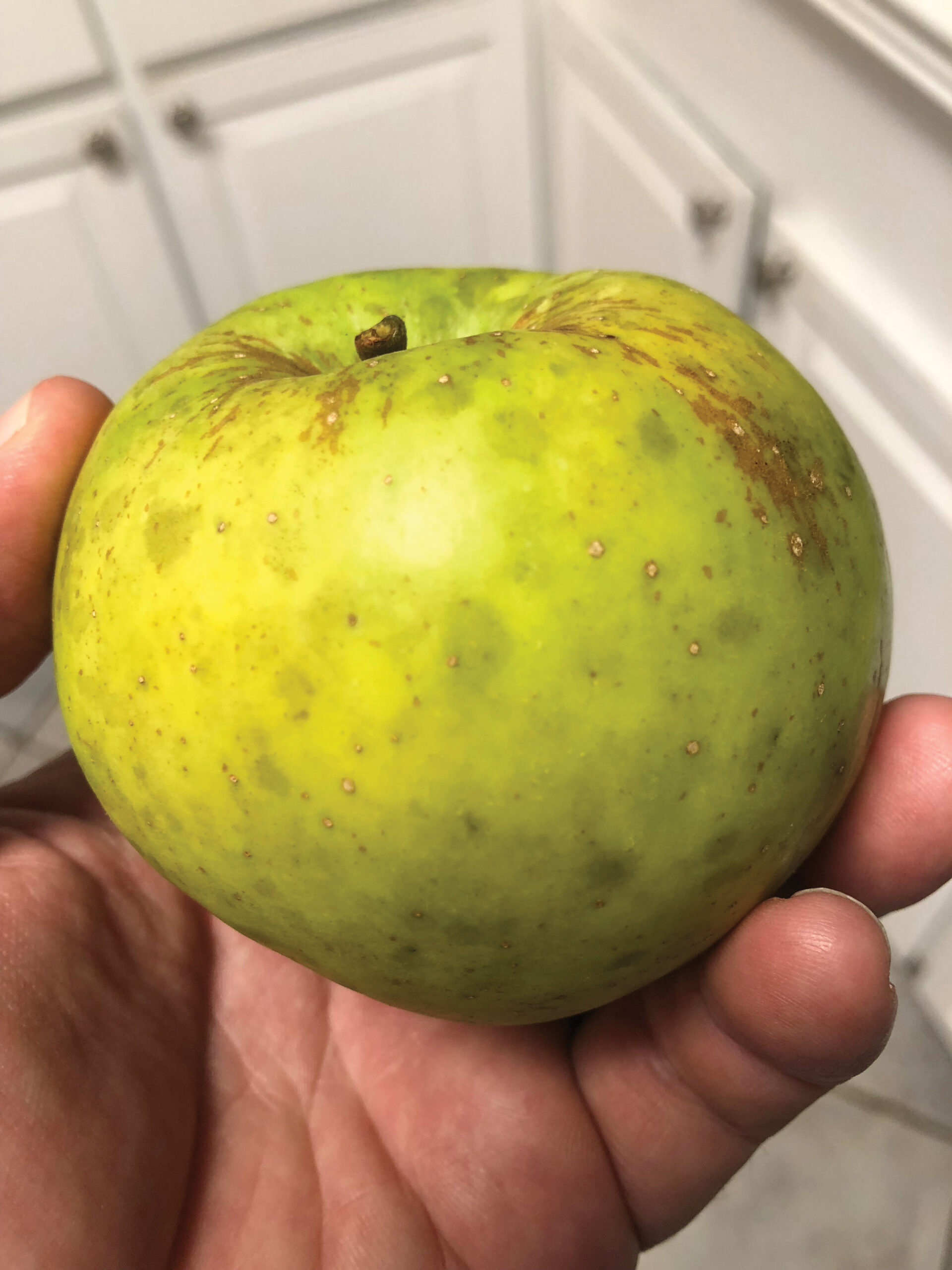
The prevailing paradigm is that apples (Malus domestica) won’t grow and produce in Louisiana. This isn’t true, of course. In fact, apple trees were once quite common on farms and homesteads throughout the southern United States, including the Deep South. They were more of a staple crop than we realize today. The half dozen or so apple varieties currently found in supermarkets don’t begin to scratch the surface of apple diversity. I’ve written and spoken before about how gardeners with backyard orchards should experiment more with old southern apple varieties. The old ‘Horse’ apple was likely the single most common apple found throughout the South. When an older person describes to me an apple tree they remember from childhood, more often than not, they describe the old ‘Horse’ apple to a T. There are many apple varieties with origins in the Deep South that should not be overlooked like ‘Shell’ from southern Alabama, ‘Reverend Morgan’ from Houston, Texas, and ‘Sam Hunt’ and ‘Cauley’ from Mississippi. Even Louisiana is home to several apple varieties like ‘Basseer,’ ‘Bossier Greening,’ ‘Fall Cluster,’ ‘Louisiana,’ and ‘McMullen’ from the Shreveport area, and ‘DeLee’s Red Winter,’ ‘DeLee’s Striped,’ ‘Felt’s Strawberry’, ‘Spark’s Late,’ ‘Terral,’ and ‘Woodland’ from down in Feliciana. In his seminal work Old Southern Apples (Chelsea Green Publishing), Lee Calhoun has all these Louisiana apples listed as extinct. If there is a snowball’s chance of finding one of these today, I believe it is the McMullen apple.
The McMullen Apple
Joseph Cullen “Joe” McMullen was born in Kimble County, Texas, on November 24, 1844, one of four children born to his father, Cullen McMullen, from Rowan County, North Carolina, and his two wives, Abigail and Harriet. After a circuitous route through Tennessee, Mississippi, and Texas, the family settled in northern DeSoto Parish near Stonewall. As far as I can tell from both old and new maps, the old McMullen property stretched east to west along what is now State Road 3276 and northward adjacent to what is now Missile Base Road. The property has been parceled up and little of it remains in the family. Joe fought for the Confederacy during the Civil War and was wounded during the Battle of Mansfield (The Battle of Sabine Crossroads) on April 8th, 1864. His wounds were problematic for the rest of his life, even prompting surgery thirty years later. Not much is known about Joe’s years after the war except he was a cotton farmer.
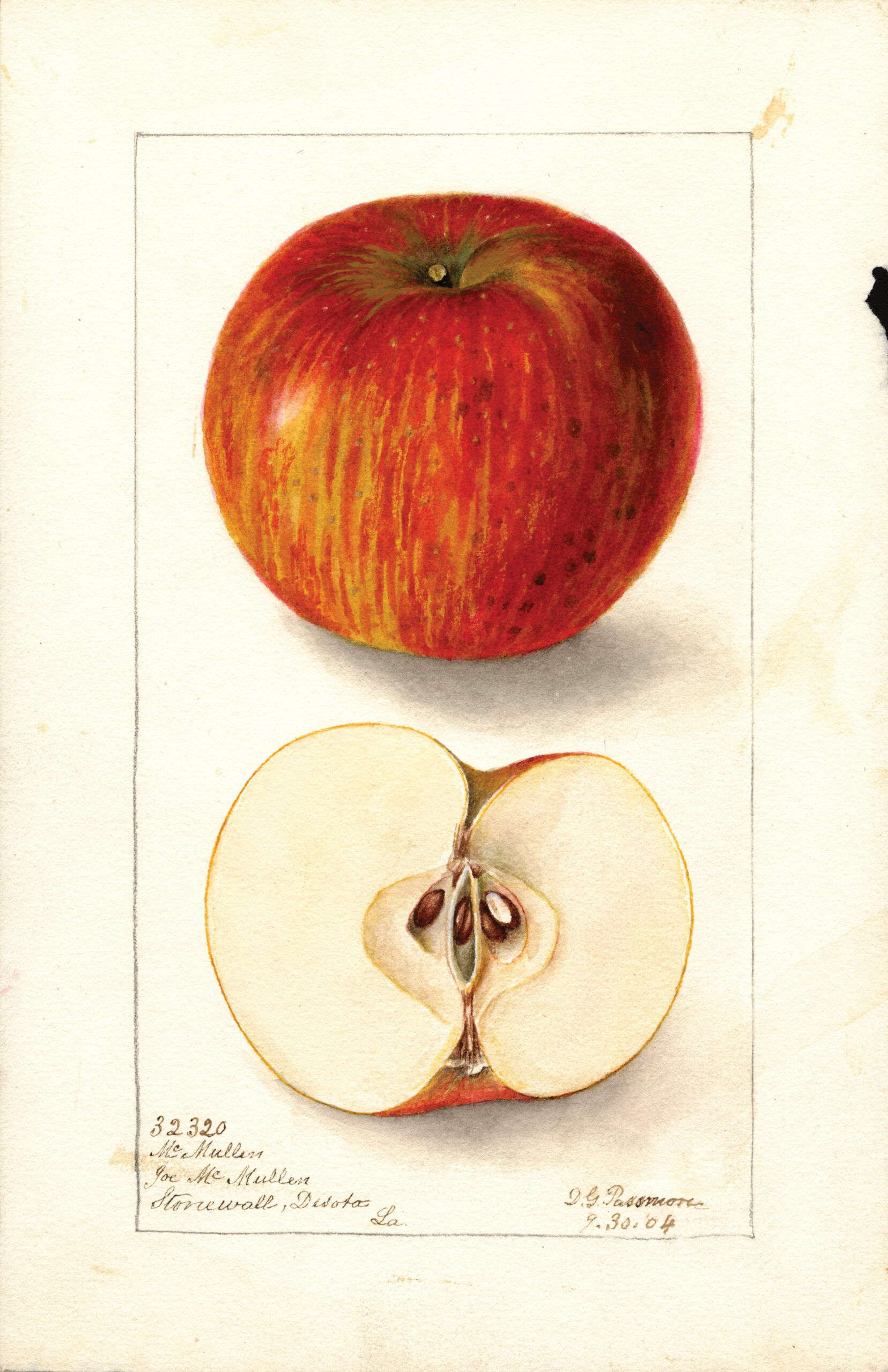
Sometime in 1888, Joe purchased a bundle of fruit tree whips from a salesman claiming to be a nursery owner from Long Beach, Mississippi. Some of those fruit tree whips were apple trees, and Joe assumed they were seedlings. He planted them and, of course, some didn’t survive. However, the trees that did survive produced a crop of quality apples, and all produced the same apple, after seven years of growth. The possibility of the trees being seedlings is essentially zero because apples rarely, if ever, breed true from seeds. Joe most likely purchased root sprouts of an ungrafted tree which would, of course, all produce the same apple if they were taken from the same tree. By 1904 Joe’s health had deteriorated to a point where long-distance travel was impossible for him. However, someone encouraged him to exhibit his apples at the Louisiana Purchase Exposition, aka the 1904 St. Louis World’s Fair. The Exposition commemorated the 100th anniversary of the Louisiana Purchase and was supposed to have opened in 1903 but was delayed a year to allow exhibitors from all over the world ample time to ship exhibits and to travel to St. Louis. The Louisiana Purchase Exposition finally opened on April 30th and closed on December 1st in 1904. Joe’s efforts would not go unrewarded; his apples won a bronze medal along with other fruit exhibits from Louisiana including peaches from Calhoun that won a silver medal. In February 1904, two months before the Louisiana Purchase Exposition opened, a group gathered in Garig Hall on the campus of LSU for the first annual meeting of the newly reorganized Louisiana State Horticultural Society. Attendees included such horticultural luminaries as Arthur K. Clingman, who operated a nursery first in Homer then in Keithville from 1874 until his death in 1919, and James P. Bowman of St. Francisville, the son-in-law of Martha Turnbull of Rosedown Plantation. Eugene J. Watson of the North Louisiana Experiment Station (Calhoun) was also present. At this first annual meeting, John DeLee of Teddy, Louisiana (present day intersection of Highway 422 and Ed Freeman Road in East Feliciana Parish) gave a presentation on apple production in Louisiana. And, as if 1904 wasn’t already a penultimate year for the McMullen apple, it became the subject of a watercolor painting by renowned botanical artist Deborah Griscom Passmore (1840 – 1911), who contributed over half of the 7,500 watercolor paintings of fruit commissioned by the USDA in 1887. Artist Bertha Heiges (1866 – 1956) contributed a second painting of the McMullen apple in 1905. The Passmore and Heiges paintings show us exactly what the McMullen apple looked like.
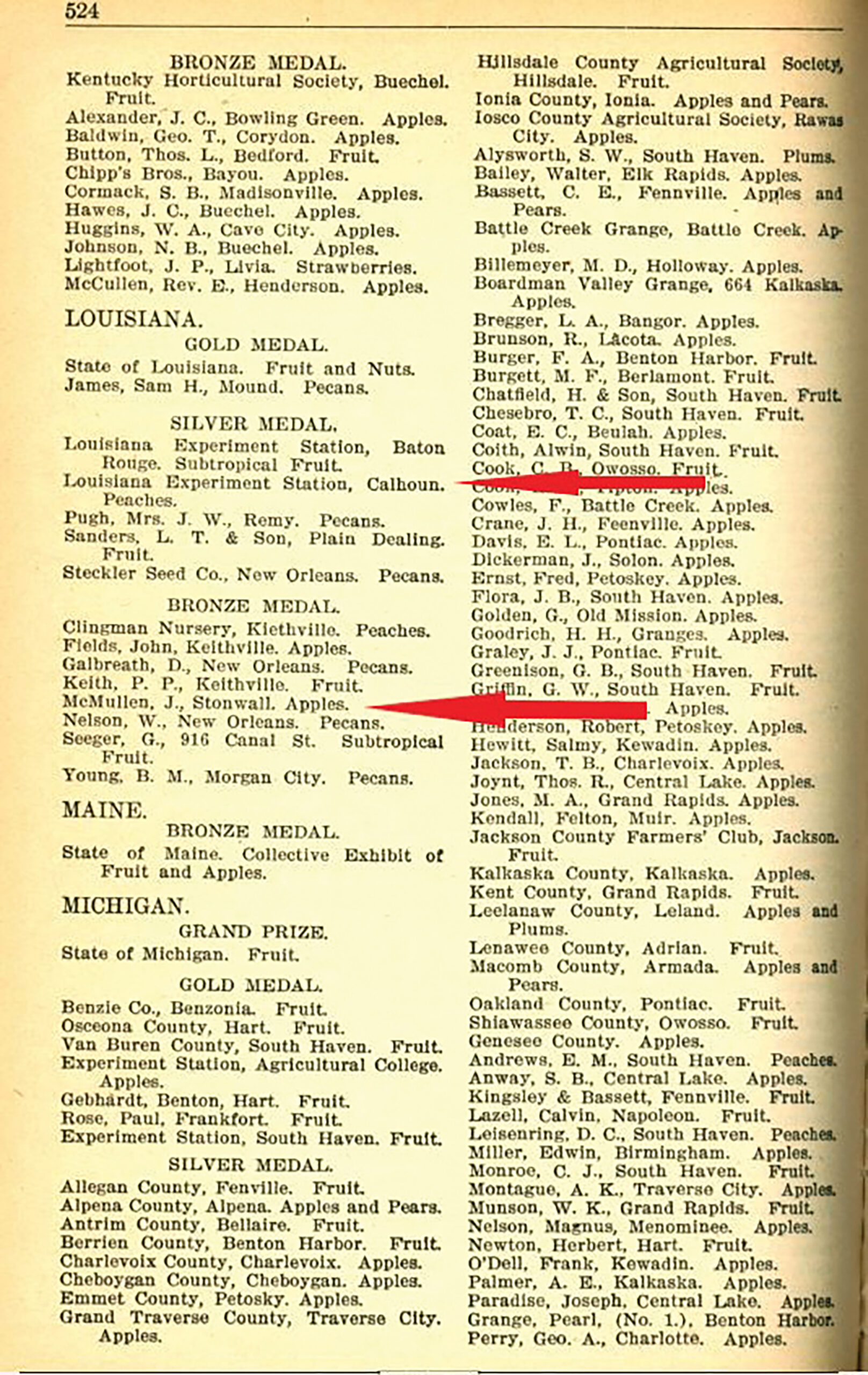
The second annual meeting of the Louisiana State Horticultural Society was held in January 1905 in Shreveport. A Mr. Nelson gave a presentation about this new Louisiana apple on Joe McMullen’s behalf. Mr. Nelson was most likely John Massengale Nelson, Sr. (1847 – 1924), the County Agent at that time. In the question-and-answer session following his presentation, Nelson was asked if this apple may be of commercial value in Louisiana. He reported that Joe “gathered from five to nine bushels to the tree off six trees and sold them in Shreveport at $1.35 per bushel.” Nurseryman Arthur Clingman stated that while apples may not be a commercial crop in Louisiana, they were certainly a valuable crop. Curiously, the McMullen apple never appeared in Clingman’s catalogs which advertised a variety of summer, fall, and winter apple varieties for Louisiana home orchards.
Joe McMullen died on February 17th, 1906. In 1907, J. M. Nelson’s name appeared in a brief newspaper advertisement for the McMullen apple; trees were $1.00 each or $10.00 per dozen. How times have changed. Nelson evidently took over propagating this apple for the McMullen Family. In 1908, when the Louisiana State Horticultural Society met in Minden for the fifth consecutive year since reorganizing, one of Joe’s daughters by his second wife gave another presentation on the McMullen apple. Harriette Belle “Hettie” McMullen was not quite 18 years old when she read the exact same presentation that J.M. Nelson had read in 1905. Hettie added that the original six surviving McMullen apple trees were still healthy and productive and stood at about fifteen feet tall at that time. Hettie further reported that 1,000 trees had been grafted sometime in 1906, cared for through the summer; and in November of that year, an orchard of 450 of those trees had been established. Twenty-five hundred McMullen apple trees were propagated in 1907, and 6,000 trees in 1908. What happened to these trees?
J.M. Nelson died in 1924 at age 77. His descendants are still in the Stonewall area, and I have communicated with a great-great-grandson. Hettie McMullen Fincher lived 99 years. She died on February 2nd, 1990, and with her the location and the fate of the orchard of 450 trees as well as the fates of the thousands of grafted trees. My hope is that there is still an old McMullen apple tree out there somewhere.