



FATHER WHIT STODGHILL
ARTICLE BY GEORGIANN POTTS
AND PHOTOGRAPHY BY KELLY MOORE CLARK
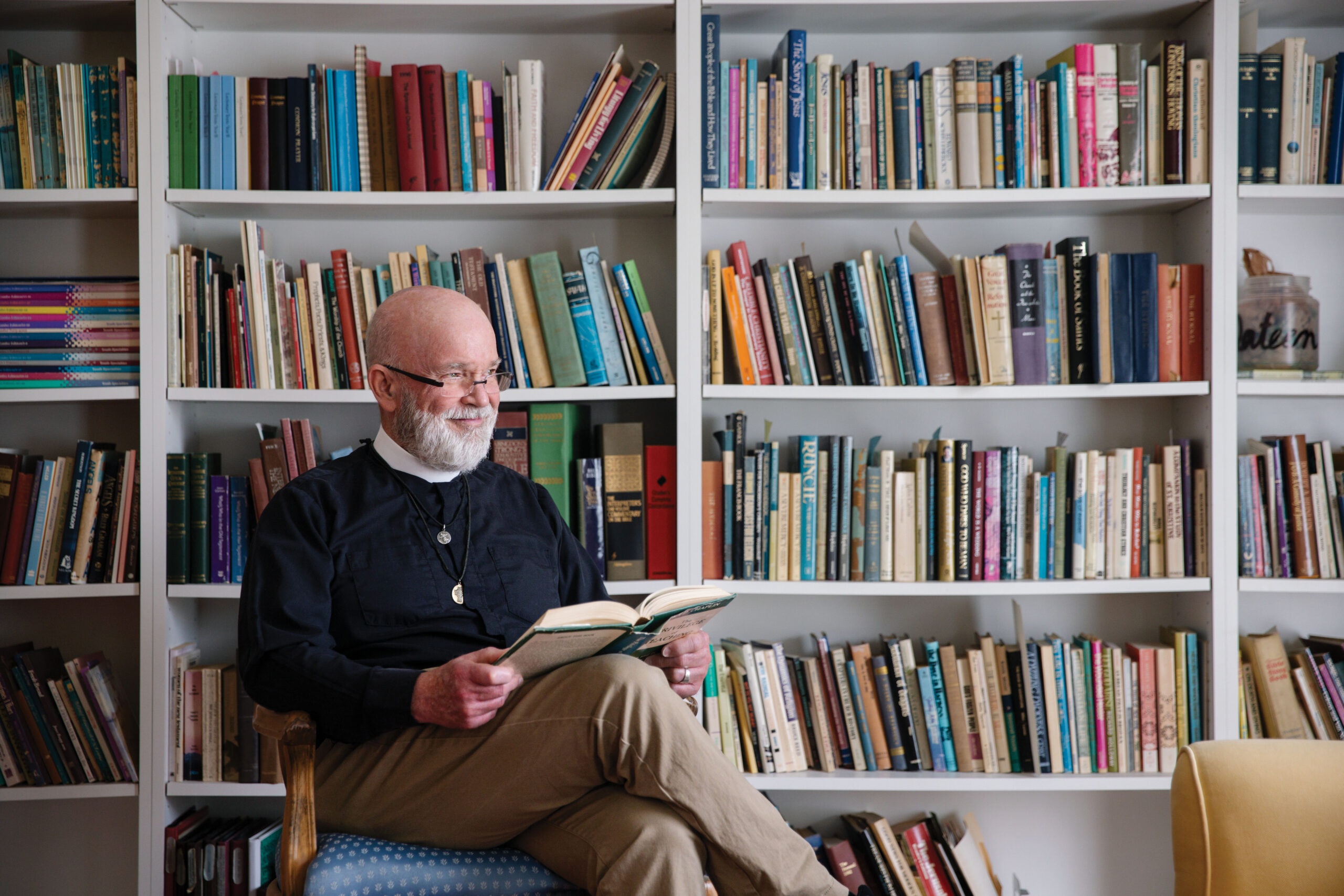
The Rev. T. Whitfield Stodghill, III has worn many hats during his lifetime — including motorcycle helmets! His career has ranged from working the concession stands during football games at Northeast Louisiana University (now the University of Louisiana Monroe) to working as an architect in Louisiana and California. His career took a major turn in 1990 when he discerned that God was calling him to serve the Church. His decision to serve was an easy one; he had been steadily drawn toward that work for some years. Whether to become an Episcopal priest or a Jewish rabbi was the harder decision. After much prayer and contemplation plus turning the decision over to God, he knew the answer.
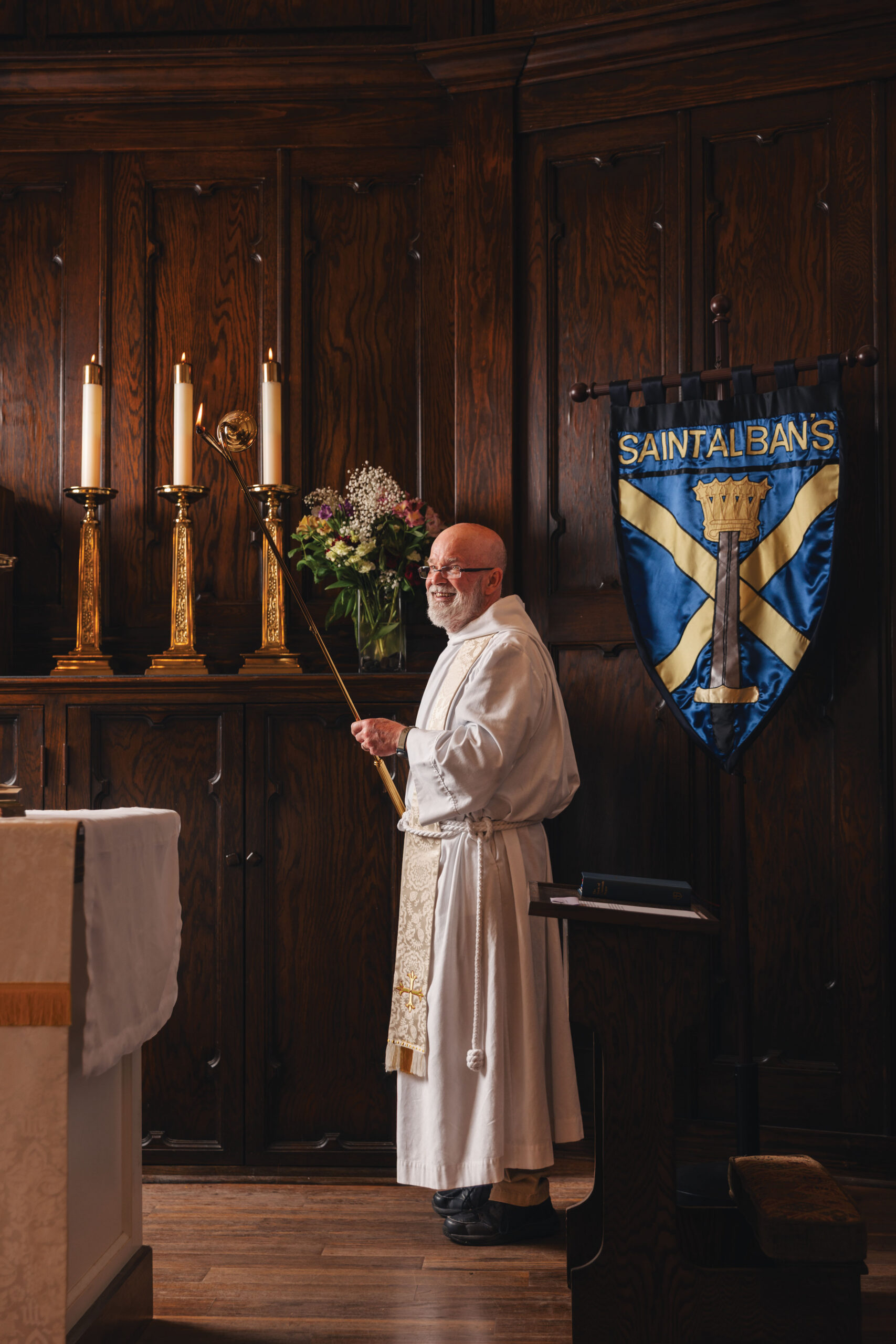
Today Father Whit serves as Priest for St. Alban’s Episcopal, a position he has held since 2011. Because of an amazing life’s journey that led him to the priesthood, and because of the life-changing work he is doing in that priesthood by bringing together a community of worshippers, Father Whit Stodghill is our June Bayou Icon.
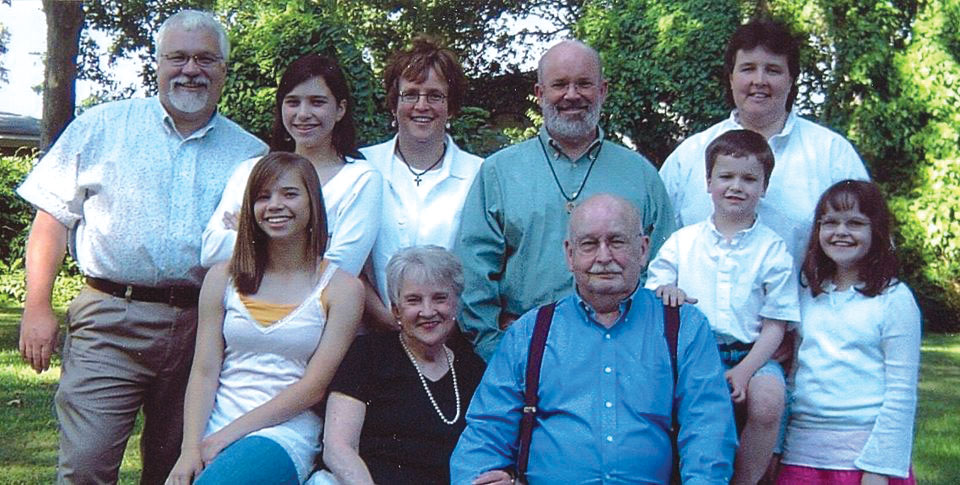
Father Whit’s family tree holds several religious connections. His paternal grandfather, Thomas Whitfield Stodghill, was born in rural Kentucky, and was a retired Methodist minister. Aside from the ministry, Whit’s grandfather also owned a lumber yard in Winnsboro, Louisiana. Whit’s paternal grandmother, Jewell Taylor, was born in Winnsboro, Louisiana, and was a school teacher. That branch of the family was primarily Methodist.
There are also a cousin and one uncle who were Baptist ministers on his mother’s side of the family. In the early 1980’s Whit discovered a female cousin living in Kentucky who shares his name – Whit Stodghill – and is an Episcopal priest (as well as a college chaplain and former professional tennis player).
Whit’s dad, Thomas Whitfield Stodghill, Jr. (aka “Bubba”), was born in Winnsboro. His mother, Mary Durr, was born in Mansfield. Her parents were Jimmie Harlow Durr, an Agriculture Service agent, and Evelyn Corinne Durr, a school teacher. Whit’s mom and dad were high school sweethearts and married at the Methodist Church in Winnsboro in 1957 after both graduated from Louisiana State University, Bubba in Architectural Engineering, and Mary in Elementary Education. The couple had two children, son Whit, and daughter Stephanie, born two years later.
Whit’s family moved to Monroe from Winnsboro in 1964 when Whit was 6 years old. Whit’s dad had taken a job with Johns and Neel Architects there. The firm was designing Monroe City Hall and the Monroe Civic Center at the time. In 1968, Whit’s dad opened his own office and practiced architecture until he retired in 2006. Whit’s mom worked as a full-time mother while her children were small, but returned to teaching in 1987 as an elementary school teacher. Toward the end of her successful teaching career, she taught Instructional Technology with the Monroe City School System until she retired in 2007.
Whit remembers that he and his sister had ideal childhoods. “Our parents loved one another and us deeply. We lived in the same home in Monroe for our entire childhood,” Whit says. The siblings enjoyed a close relationship built on common loves, including a love for riding motorcycles. “We rode motorcycles together mostly in the woods,” he recalls with a laugh.
The family enjoyed camping trips together as well as more formal family trips to Six Flags in Dallas/Fort Worth, to the Jackson Zoo, and to Hot Springs, Arkansas. Whit and his sister often spent time with their grandparents, and usually spent an entire week in Winnsboro each summer. There they played and went to the rodeo. Major holidays – Thanksgiving and Christmas — found them gathered together with cousins.
Education Means Change
Whit enrolled in 1st grade at Sallie Humble Elementary where he had wonderful teachers. He experienced integration there for the first time when his school integrated during his 5th grade year. There, also, he had his first African-American teacher, Ms. Mosley. Whit’s 7th and 8th grade years were spent at Lee Junior High (now Neville Junior High). For his first year in high school, he was a Neville Tiger. There he took his first Mechanical Drawing class and completed Driver’s Education. He enjoyed being in a large high school and many older students, even seniors, helped him fit in.
In fall 1971, Whit and his sister transferred to Ridgedale Academy in West Monroe. Ridgedale was a K-12 small private school so they both knew not only their classmates, but other students there plus their families. “The downside to our experience at Ridgedale was our separation from friends who remained in public schools and, of course, the experience of being in a segregated school environment,” Whit explains. “The experience of a small school allowed us to be a part of everything. I had a number of very good teachers and coaches there.”
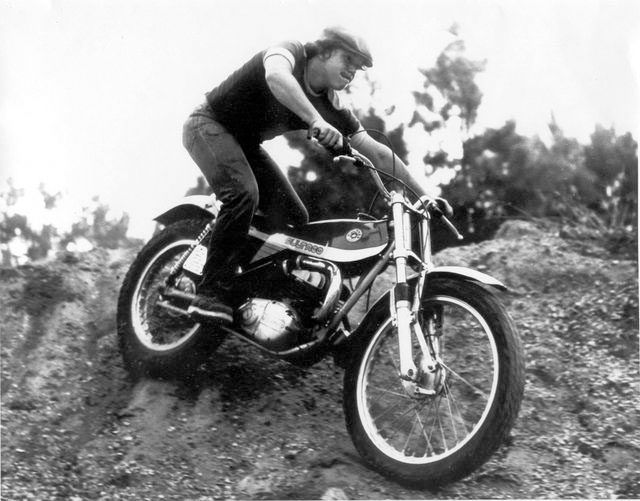
During high school, Whit began competing in motorcycle events as a serious contender. The family traveled to motorcycle events in Mississippi, Arkansas, Texas, Oklahoma, and Louisiana. Whit says that aside from his parents, among his most influential mentors during that time were adult friends who were fellow motorcyclists. In that group were artists, construction workers, and some in the motorcycle industry. “They taught me persistence, practice, and sportsmanship,” Whit says. “One of the most difficult lessons was how to handle besting a hero and friend at a motorcycling event, and later how to handle being bested by a younger friend who I mentored.”
What Shall I Be?
When time came to go to college, Whit had no specific career in mind. He did toy with the idea of a career in motorcycling, but was also drawn to working in a profession that helped others. Law enforcement, psychology, and psychiatry were all on his “maybe” list.
In 1976 Whit enrolled at Louisiana Tech University with no declared major. He spent two quarters there with good roommates and some good friends from high school. He realized during the second quarter when he did poorly in his first calculus class that he needed a sense of direction. Fortunately for both Whit and for his dad, at the time his father was particularly busy on a couple of projects. One was the repair of a very well-designed but fire-damaged modernist residence on Bayou DeSiard and the other was the renovation of a bank in Rayville. Both required that the space be measured and documented prior to the redesign, both skills that Whit had. “I went to work with Dad and did not return for my 3rd quarter at Louisiana Tech,” Whit says. “It was very rewarding, and I enjoyed working with both Dad and Mom. She was Dad’s secretary and office manager.”
With that work experience, a career appeared. In late August 1977, Whit decided to enroll at Louisiana State University to study Architecture. “When I arrived on campus, I was informed that classes started the following week. I ran from building to building, had my Tech transcripts sent, and got myself enrolled,” Whit remembers with a chuckle. “A week later, I was in Baton Rouge. My first dorm space was on the fourth floor of the stadium.”
Architecture – A Good Fit
Among many fine professors Whit encountered at LSU, one of his favorites was Dr. Robert Heck. Dr. Heck taught architectural history, and when he first arrived at LSU in the mid-‘50’s he had taught Whit’s father. “Dr. Heck was older, very smart, a great teacher, and fun to be around,” Whit recalls. “We all loved him. People who are good at what they do have always inspired me to want to be good at the things I want to do. Dr. Heck was like that.”
A special memory of that time at LSU that Whit shares with his sister Stephanie is traveling as part of LSU London, a 6-week summer program that Dr. Heck led. Stephanie had followed her brother to LSU and after several changes of major, majored in Interior Design. She enjoyed the LSU London program with her brother. It was an exciting time as this was the summer that Prince Charles married Lady Dianna.
While at LSU, Stephanie fell in love with one of Whit’s classmates, Guy Carwile, and married him. Today she is an Assistant Professor of Interior Design at Louisiana Tech. She also holds an MFA degree and is a painter and printmaker. Her husband is a Professor of Architecture at Louisiana Tech. He is a photographer, architectural historian, and author and documents significant buildings in the region.
During his university years, Whit recognized that he had a natural strength in math and technical courses. However, it was then that he also learned to enjoy reading. English classes at both universities exposed him to things that he might not have picked on his own. Later in his life, Whit’s love of reading would become critical in his pursuit of spiritual ideas.
A second course at LSU also deeply impacted Whit’s life. Taught by Professor Walter Wendler, the class was “The Power of Craft.” In it, Whit read and studied the work of an architect at the University of California at Berkeley. “His name was Christopher Alexander, and his work centered on the study of, and creation of beauty and the spiritual aspects of space, construction, and design.” Whit remembers. “It planted another seed, one that would continue to grow.”
When they first moved to Monroe, Whit’s family attended the Methodist Church there. In 1972, however, the entire family became Episcopalians. They were all confirmed at St. Thomas’ Episcopal Church at the old location on Filhoil Avenue. “We started attending there with one of my sister’s friends and her family,” Whit recalls. “The small church quickly became home and was a better fit than the larger Methodist Church in Monroe.” During his time at LSU, Whit attended worship occasionally at the Episcopal Church on campus there, but not regularly. Because studying architecture involved long studio hours and late nights of work, most of those students were cloistered with one another and rarely did anything else.
Experiential Learning
While at LSU, Whit met his first wife, an architecture student a year behind him. They married in 1983 after her graduation and moved to Monroe. Whit went to work with his dad and she worked with another architect in town. Whit worked for banks, churches, residences, and commercial businesses. A favorite project with his dad was renovating an old church to become the Ronald McDonald House.
Whit became involved at St. Thomas when he came home, but also became active at Temple B’nai Israel. His wife was Jewish and had family in Northeast Louisiana and in Monroe. “My time with the Jewish community was an important part of my spiritual formation, and it remains a close connection,” Whit says.
As the two were developing their architect careers, Louisiana moved into a deep recession. Many architects were struggling, and many firms closed. Whit took a part-time job managing a yogurt shop to help. At the same time, Whit realized that he wanted to go back to school.
In 1987, the couple moved to the San Francisco Bay area where each had accepted jobs with firms in that area. Whit went to work with a family of Chinese architects, both parents and their two sons were in the practice. “We did restaurants, and other commercial facilities,” Whit says. “Obviously it was a huge change.” Later he joined another firm in Oakland that specialized in public schools. There he served as a project architect.
As he settled into the work, Whit achieved another goal. He was able to work as a volunteer on several of Alexander’s projects doing actual construction work while learning more about Alexander theories. While this work was fascinating, Whit was finding something deeper and more interesting to him than architecture. He was beginning to think that he was being called to be a priest or a rabbi.
On his first weekend in California, Whit had found a new Episcopal church home. It took longer, but his wife found a synagogue. They worshiped at both. As he thought more about entering the priesthood, Whit discussed his thoughts with his priest and his rabbi.
The idea of Whit leaving his architecture career to pursue a vocation in the Church or the Synagogue was not something his wife could accept. They separated in 1991 and divorced in 1992. Even then, Whit continued worshipping and studying and participating in both the Church and the Synagogue. “I was still trying to find my call,” Whit says. It was a stressful time, but friends from both communities helped him survive and heal.
A Singular Decision
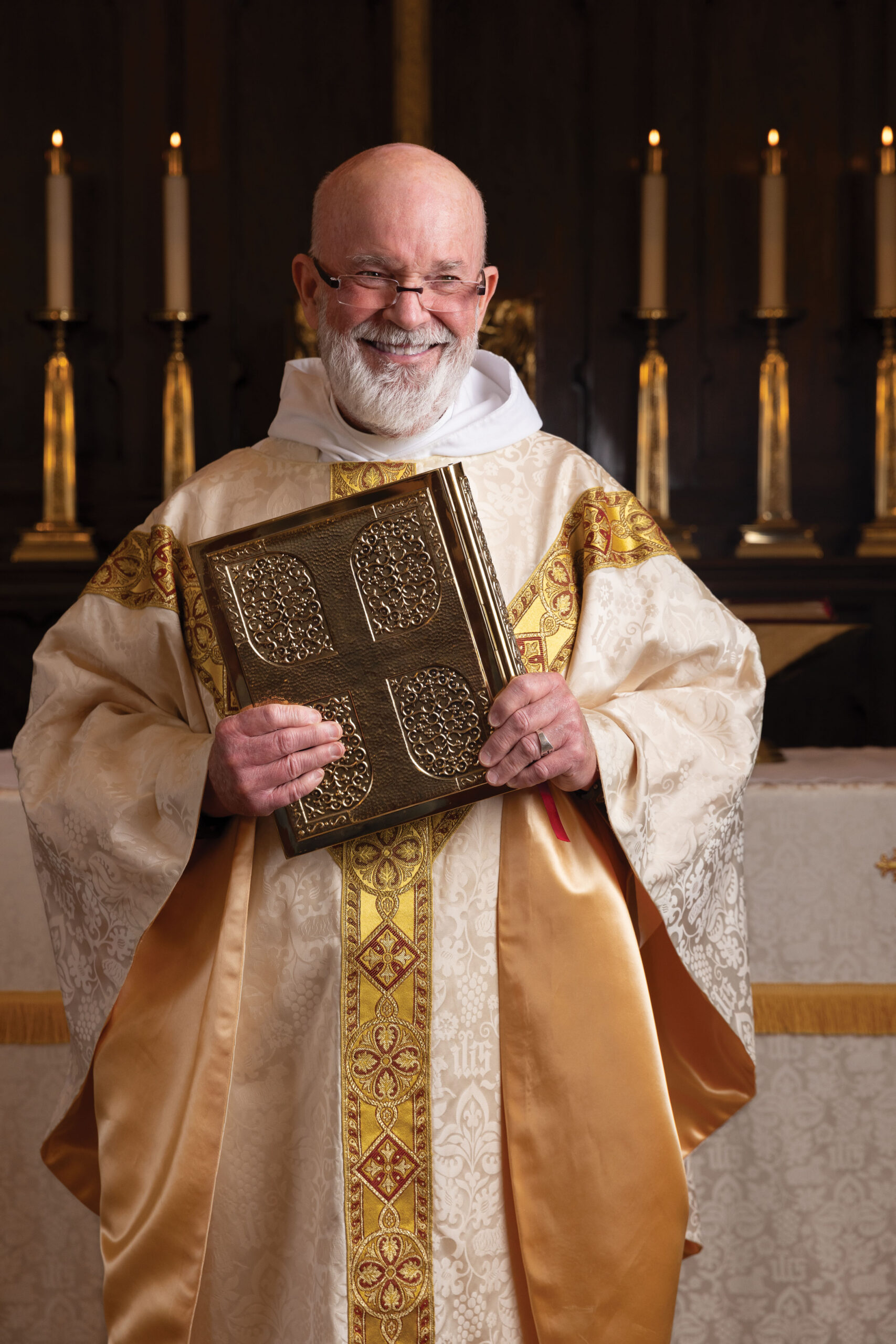
Whit was certain that he was called to an ordained ministry, but he didn’t know whether that was as a priest or a rabbi. “Study and worship in both places informed and deepened my love of both,” Whit says. After careful thought and praying to God to show him the way, Whit chose the priesthood. “That was not because one choice was better than the other, but my willingness to be either let me find the best choice for me,” Whit says.
Whit met his second wife Dawnell Smith, from Dillon, Montana, when they were in seminary together. With permission to marry granted by both his bishop and hers, the two were wed. Today Dawnell serves as priest at St. Andrew’s in Mer Rouge, Church of the Redeemer in Oak Ridge, and at St. David’s in Rayville. Whit says that she is a mentor, companion, best friend, and a wonderful mother to their two children. Daughter Tracy Ruth was born during Father Whit’s first year as a priest, and son Thomas was born two years later. Father Whit was ordained as deacon in 1996 and priest in 1997 at Grace Cathedral in San Francisco.
The family moved to Louisiana in 2000. Dawnell stayed at home with the children until they entered school. Today daughter Tracy is a Special Education teacher in Bossier City while working on a Master’s in Special Education at ULM. She serves as the Director of Able Camp – at Camp Hardtner, the camp’s session for Special Needs Adults. Son Thomas is working on his Master’s in Communication Technology at Louisiana Tech. Previously he served as the Communication Officer for the Episcopal Diocese of Western Louisiana.
A Special Challenge
The COVID pandemic presented special challenges to everyone, but no more so than to those leading in the spiritual community. Those leaders had to learn ways to maintain their communities and relationships even when they couldn’t gather physically. That forced them to grow in important ways.
Father Whit remembers that time as a time of over-compensation as he and the others struggled overtime to meet the needs of their flocks. “During the COVID pandemic, the joke was “Just like that, we all became televangelists!” Father Whit remembers with a laugh. “There is great truth in that.”
When asked if an aspiring young person were to ask him why he/she should consider a career in pastoral service, Father Whit’s answer was immediate. “If you are called to serve the Church, there is really nothing better,” Father Whit said. “I remember coming to the decision that I wanted to serve the Church, even if I had to do something else to earn a living. When you truly want to live in the community of the Church, and to serve and work with the people of God – no other calling can replace that desire.”
When he reaches 72, Father Whit will retire through the mandatory retirement policy for Episcopal clergy. At that time, he will be able to do all of the wonderful parts of being a priest but will be relieved from managing the daily affairs of the Church. Clearly, Father Whit looks forward to continuing to serve for as long as he lives. With Dawnell by his side and continued meaningful work ahead, the future is bright.
Mahatma Gandhi (1869 – 1948) wrote “The best way to find yourself is to lose yourself in the service of others”. That is a truth that all should live by. Father Whit certainly does.