



CONCEALING THE TRUTH
by Guy Miller, Vice Chair Emeritus, Chennault Aviation and Military Museum
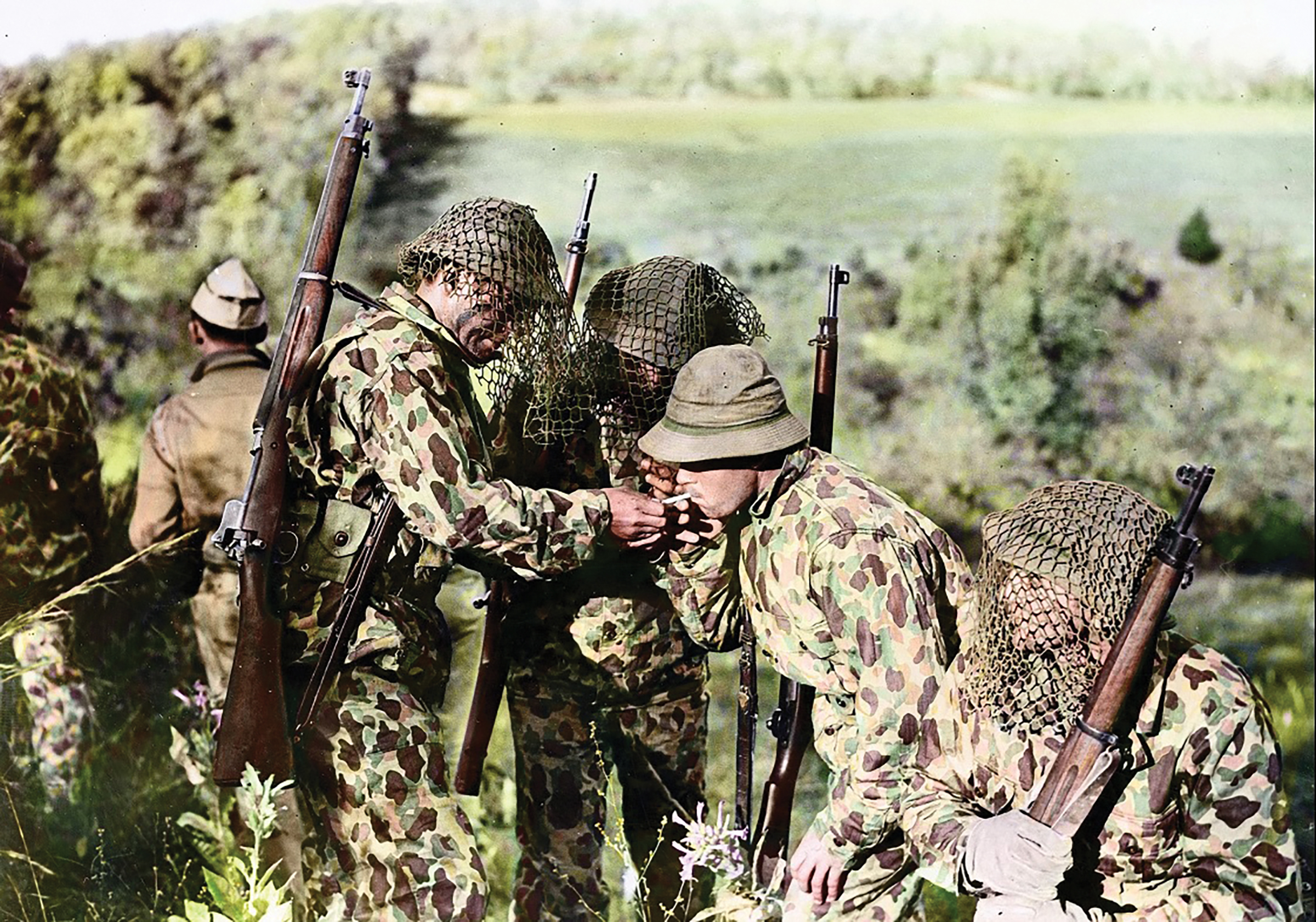
In the Sportsman’s Paradise camouflage clothing is worn all the time. Camo is a hunting necessity, a hobby self-identification and a fashion statement all in one. Yet camo for hunting and fashion became popular only within my lifetime and its provenance is found in military camouflage.
The purpose of camouflage is to either mimic something else or to make something difficult to see. The word “camouflage” is derived from the French “camoufler” which is slang for “to disguise.” “Camoufler” is believed to come from “camouflet” which means a “puff of smoke.” It is definitely harder to see something clearly when it is hidden by a puff of smoke.
While most histories of camouflage claim it was invented by the French in WWI; that is true only for patterned camouflage. Animals have used camouflage since the Garden of Eden. The Roman Navy understood a need for concealment when it painted some galleys sea blue and clothed their sailors in the same color. During the French and Indian War of the mid-18th century, Rogers Rangers, a British unit of colonial Americans, wore green to better conceal themselves in our eastern forests. By the 19th century, European armies began switching to brown or khaki combat uniforms to better blend into natural surroundings. Those armies which still had non-earth tone uniforms quickly learned to smear mud on them for concealment.
Naturalist and artist Abbott Thayer wrote the book “Concealing Coloration in the Animal Kingdom” in 1909 which became essential reading for generals and strategists. French academics then studied the effectiveness of camouflage in combat in the 1910s. French artist Lucien-Victor Guirand de Scévola began painting camo patterns on cloth in 1914 and was put in charge of the army’s Section de Camouflage in 1915. That military then drafted other professional artists such as expressionist Paul Klee and surrealist Roland Penrose to develop new patterns.
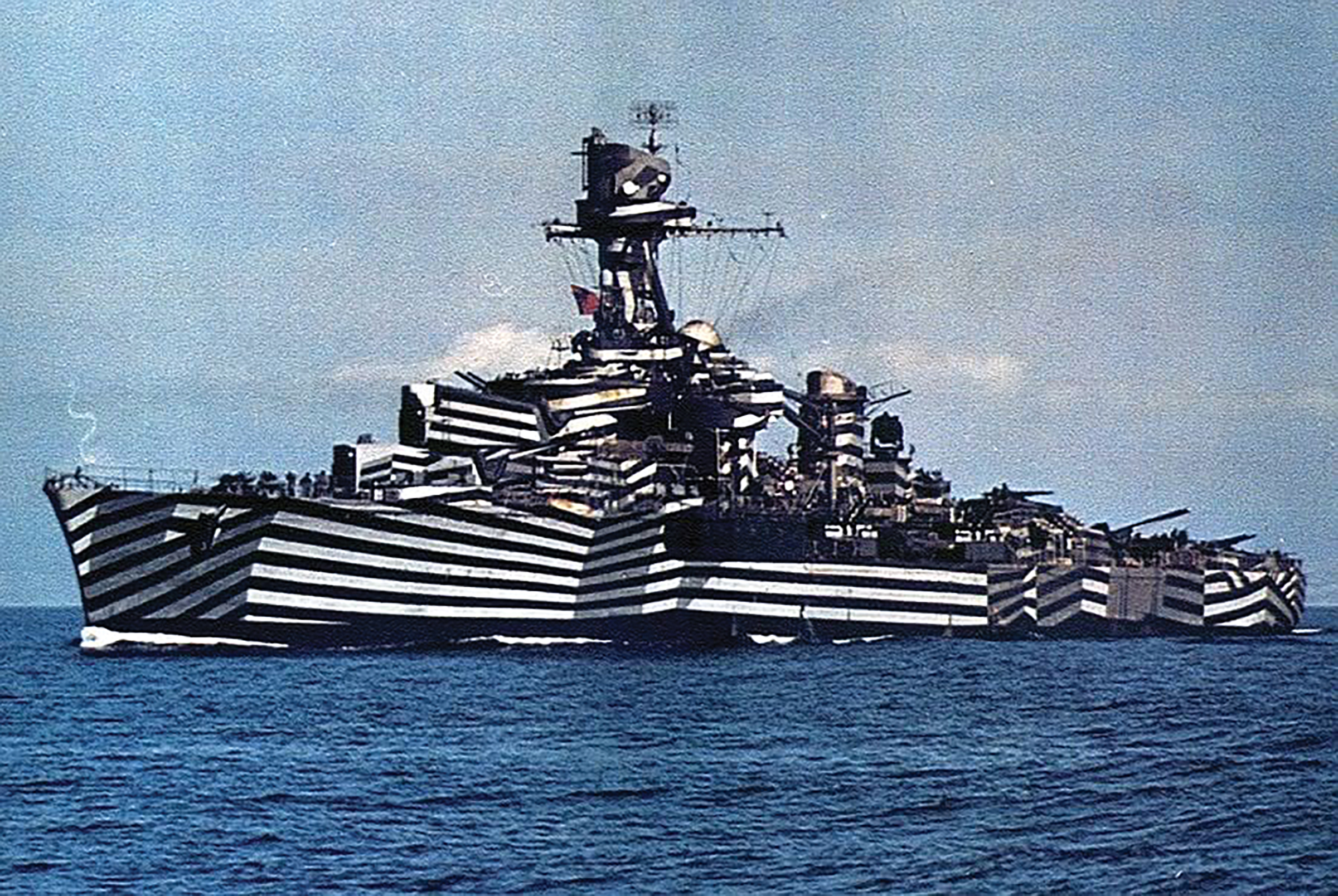
Some camouflage was developed for concealment, some, like the ‘dazzle’ patterns used on ships and some aircraft, to make it harder to determine size and speed. Aircraft were also often countershaded; that is they were painted with different schemes above and below to camouflage them against the ground and sky respectively. Camouflage was first used for these big things such as ships, airplanes and also netting to cover machine gun positions and equipment. Eventually, helmets began to be painted in camo patterns.
At this point in time, visual deception was a standard part of military strategy. When World War II began, military organizations worldwide raced to create varieties of concealment and disruptive patterns that could be adaptable to changing environments. Armies developed patterns specific to the natural colors of the combat theaters in which they fought. The German army, for instance, developed and issued no less than ten patterns, some of which were printed on reversible clothing to accommodate differing seasons and terrain.
It was not enough for an army to develop a good pattern for the local combat environment. Combat commanders quickly learned the pattern also had to be easily distinguishable from the enemy’s pattern. The U.S. Marine Corps used a pattern called “frog skin” on helmet covers and some uniforms in the Pacific theater. The U.S. Army began issuing “frog skin” uniforms in Europe but found it was often tragically mistaken for a similar pattern worn by the German Waffen-SS.
As the technology of war-fighting has improved over time, military camouflage has had to adapt. Radar rendered moot any attempt to conceal ship and aircraft size and speed with camouflage. The development of night vision devices necessitated the need for textiles designed to reflect infrared. Practical considerations and cost also limit the essentially endless choices of method and effort devoted to camouflage techniques. Paint adds drag and weight to aircraft which limits their range and payload capacity. Ground-use camouflage must accommodate both the weather and the need for rapid troop and equipment movement.
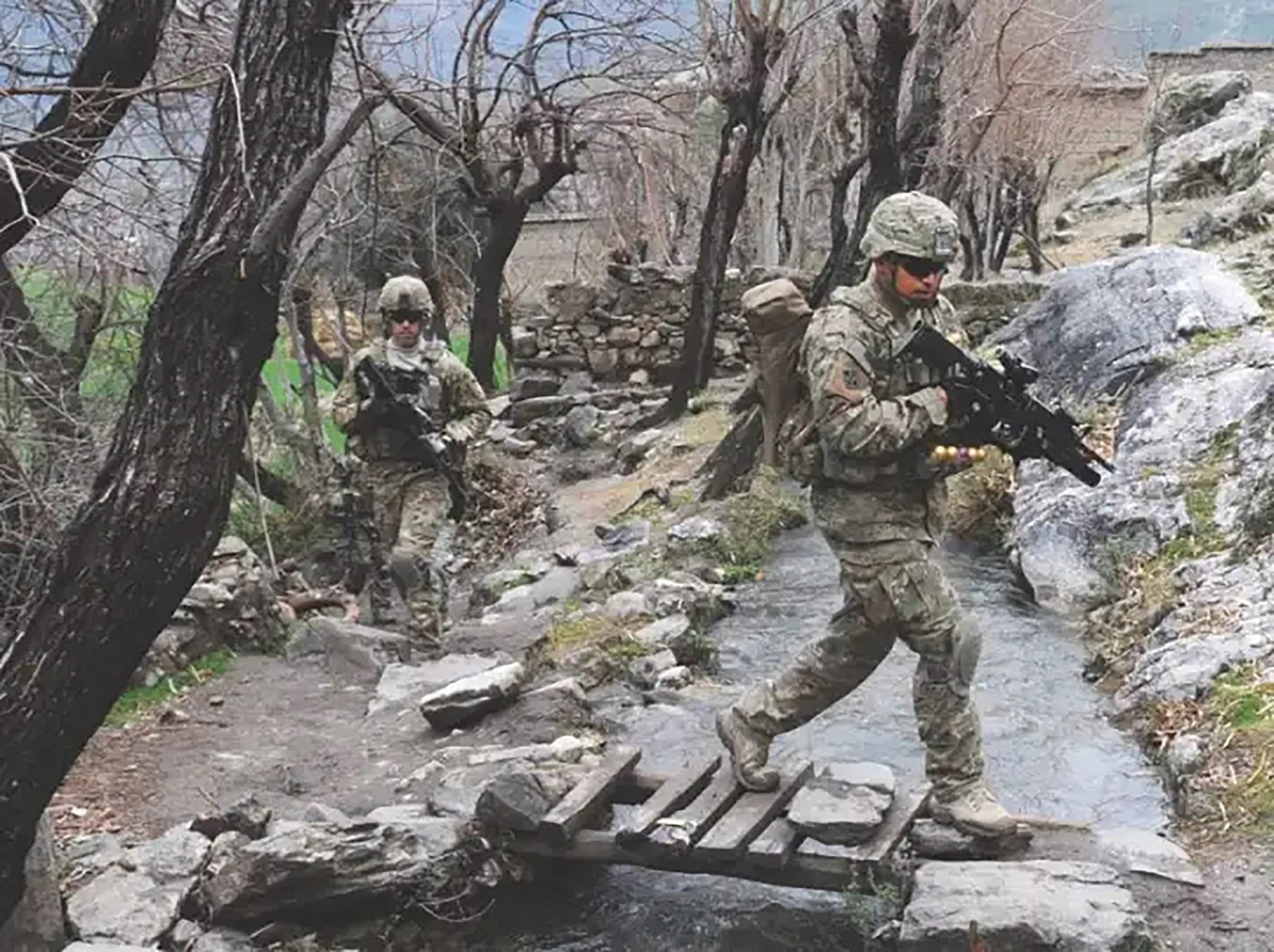
How effective a pattern is depends on colors and tonal contrast. No single camouflage pattern can be effective in all terrains. The U.S. Army made an attempt with its UCP pattern in 2004 but it proved insufficient under combat conditions.
Unlike a civilian hunter, military units might need to cross several terrain types such as woodland, farmland and urban within a single day. The photo-realistic depictions of tree bark or leaves found on hunting camo is not acceptable for combat use. Soldiers need patterns designed to work in a range of environments. With uniform costs being a substantial part of an army’s budget, most armies which operate globally have two separate combat uniforms, one for woodland and jungle and another for desert and dry terrain.
Using a 1945 German pattern as the starting point, the US Army developed the ERDL pattern in the late 1940s and it is widely known as the “Vietnam” pattern. But ERDL came in two color patterns- more brown or more green- so it morphed into the single Woodlands pattern by the 1980s. A separate tan and brown pattern was then developed for desert warfare.
Pixilated “digital” and “multicam- style” patterns with elements of scale invariance are now in wide military use. These were developed to soften the contrast between colors from both afar and near to blend in better with the surroundings. Finally, modern multi-spectral camouflage addresses visibility not only to visible light but also near infrared, short-wave infrared, radar, ultraviolet, and thermal imaging. Knowing all this, I wonder if I should switch from Realtree?