



Bayou Artist | Daija Essien
ARTICLE BY STARLA GATSON
PHOTOGRAPHY BY KELLY MOORE CLARK
Artist and MFA candidate Daija Essien channels her lifelong hustle and evolving identity into her art and screen printing brand, using creativity as a means to explore cultural belonging and self-acceptance.
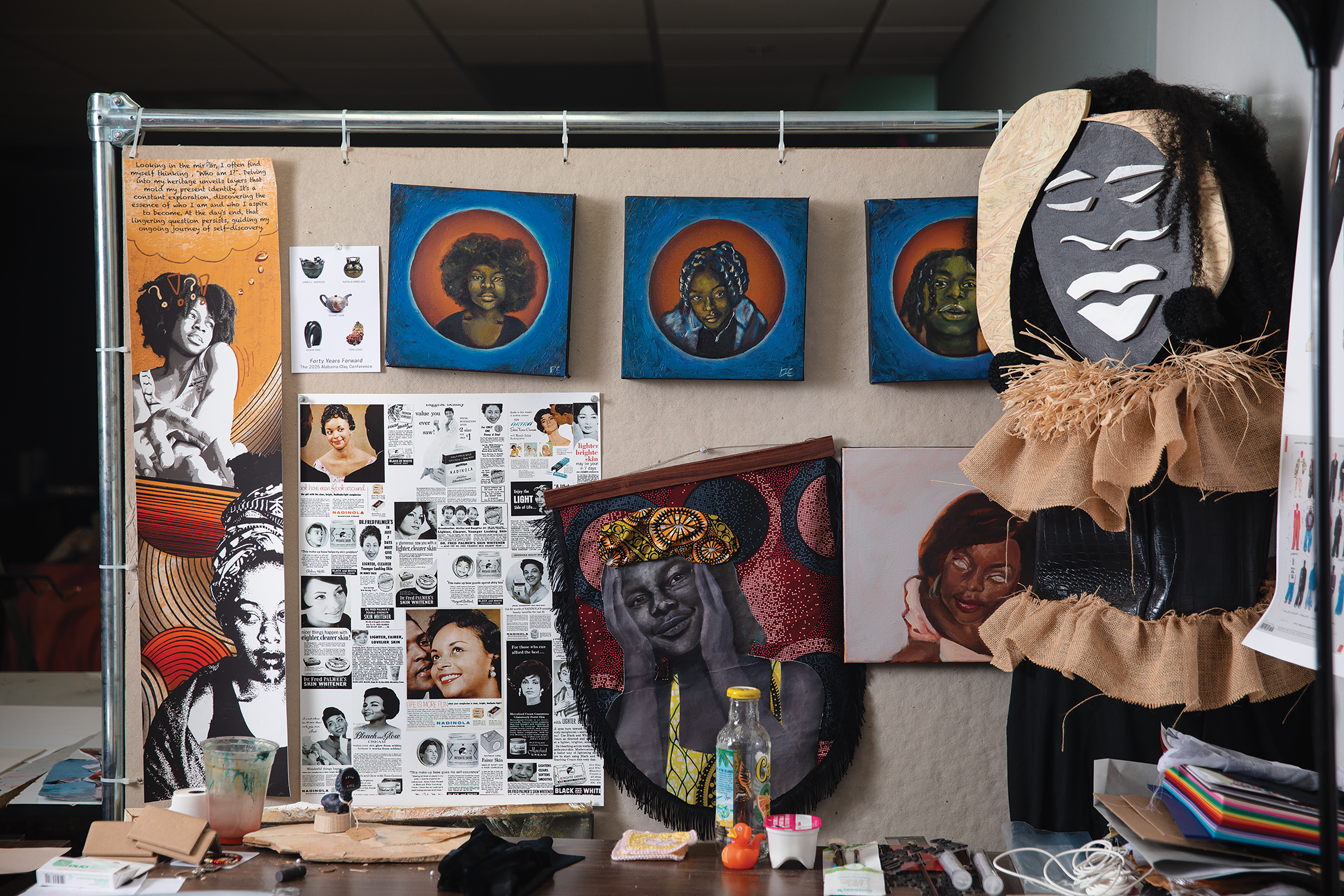
Daija Essien is a busy woman. She says she always has been, bouncing from hobby to hobby, extracurricular activity to extracurricular activity, for as long as she can remember.
“I live the go, go, go lifestyle,” Essien declares. “There’s not a time, at least since I’ve been in college or grad school, when I’ve wanted life to slow down. There have been moments of being overwhelmed by a lot of things going on. But when there’s nothing going on, I add something there.”
It only takes a quick once-over of the West Monroe native’s resume to confirm: that statement tracks.
Being a Master of Fine Arts candidate in Louisiana Tech’s School of Design certainly takes up a significant chunk of Essien’s time, but “student” isn’t the only title she carries. Essien is also a working artist who has painted murals across the state individually and collaboratively and shown and sold her mixed-media artwork in exhibitions near and far. When she isn’t painting murals, exhibiting, or making work for her MFA program, she’s teaching screen printing workshops at local venues and creating new designs for her screen-printed item brand, Make It Deeliberate.
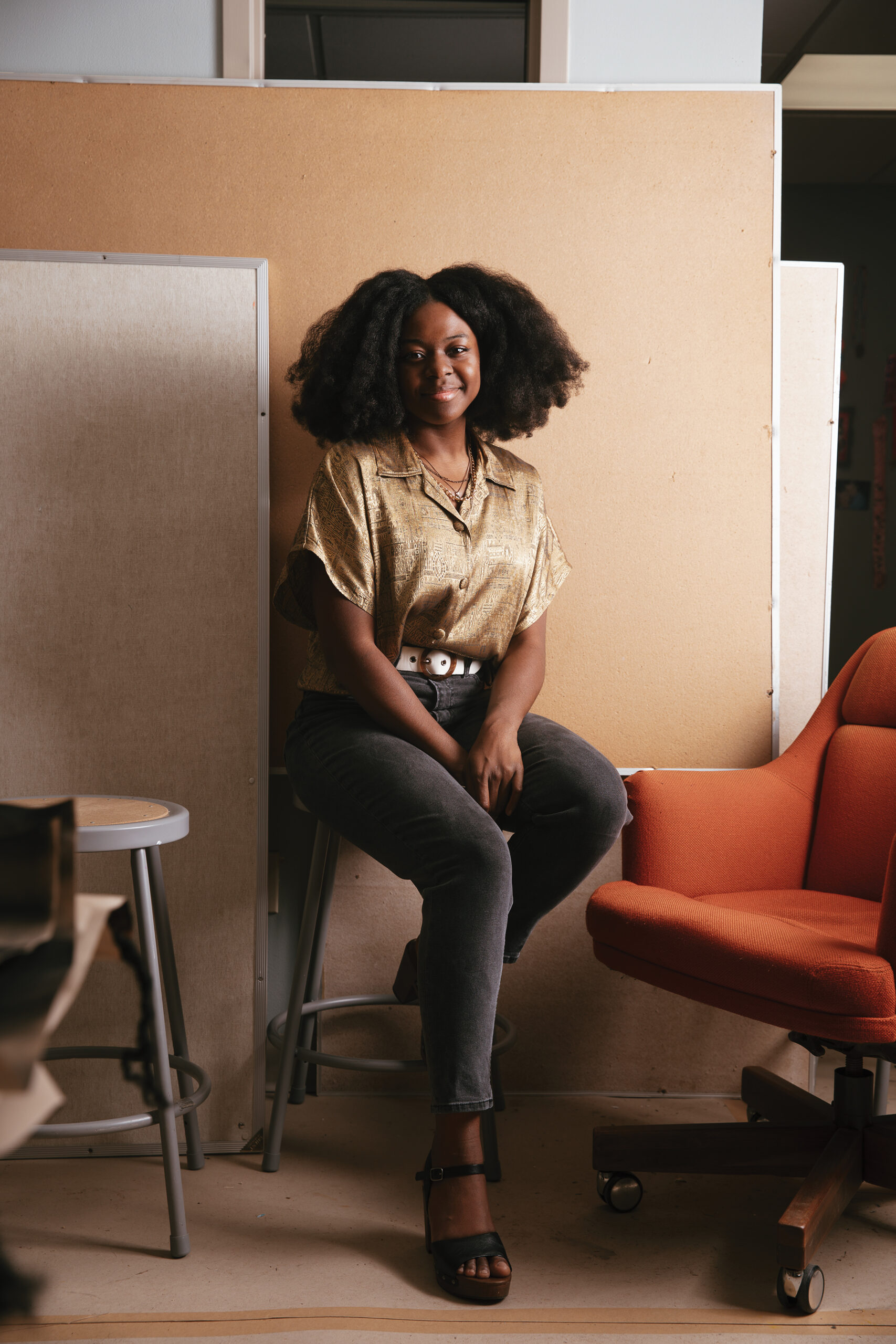
Yes, Essien’s busy indeed. But she likes it that way. She’s a self-professed workaholic who likes working toward a goal and pursuing growth. The goal she’s working toward now? Cultivating conversations about cultural identity through her art.
Essien says she’s like a chameleon, able to adapt or blend into any environment she’s in. To some extent, she believes we all can, declaring in an artist statement that each of us contains multitudes and does not have to be limited to the predefined categories society so often tries to sort us into.
Essien’s interest in cultural identity stems from her background and past experiences. She’s wrestled with her own identity for years, she says, explaining, “I lived in Bastrop and went to school in Calhoun. Those are two different spaces, one majority Black and the other majority white. I felt too white to be Black in my home life, and obviously, I’m not white, either. Multiple people at home said, ‘You talk too proper’ or ‘You just act different.’ And at school, I got praised for that type of stuff and told, ‘You’re an Oreo.’ I wasn’t sure how I was supposed to take any of that. It made me dismantle myself and figure out who I am. It really irked me because it was glaringly obvious that I technically didn’t fit anywhere.”
Further complicating Essien’s identity crisis was her Nigerian heritage by way of her father.
“That adds another section to it,” she says of her roots, “because not only did I feel like I didn’t fit into white or stereotypically Black spaces. I didn’t fit into African spaces, into my heritage.”
Essien has chosen to work through this internal conflict the same way many of her peers handle theirs: by confronting it through her art. When she entered graduate school, Essien was asked what message she wanted to convey through her creations, and cultural identity, specifically among people of color, seemed like the obvious choice for her. She eagerly took on the challenge of weaving the concept into her work, noting that doing so has been healing for her.
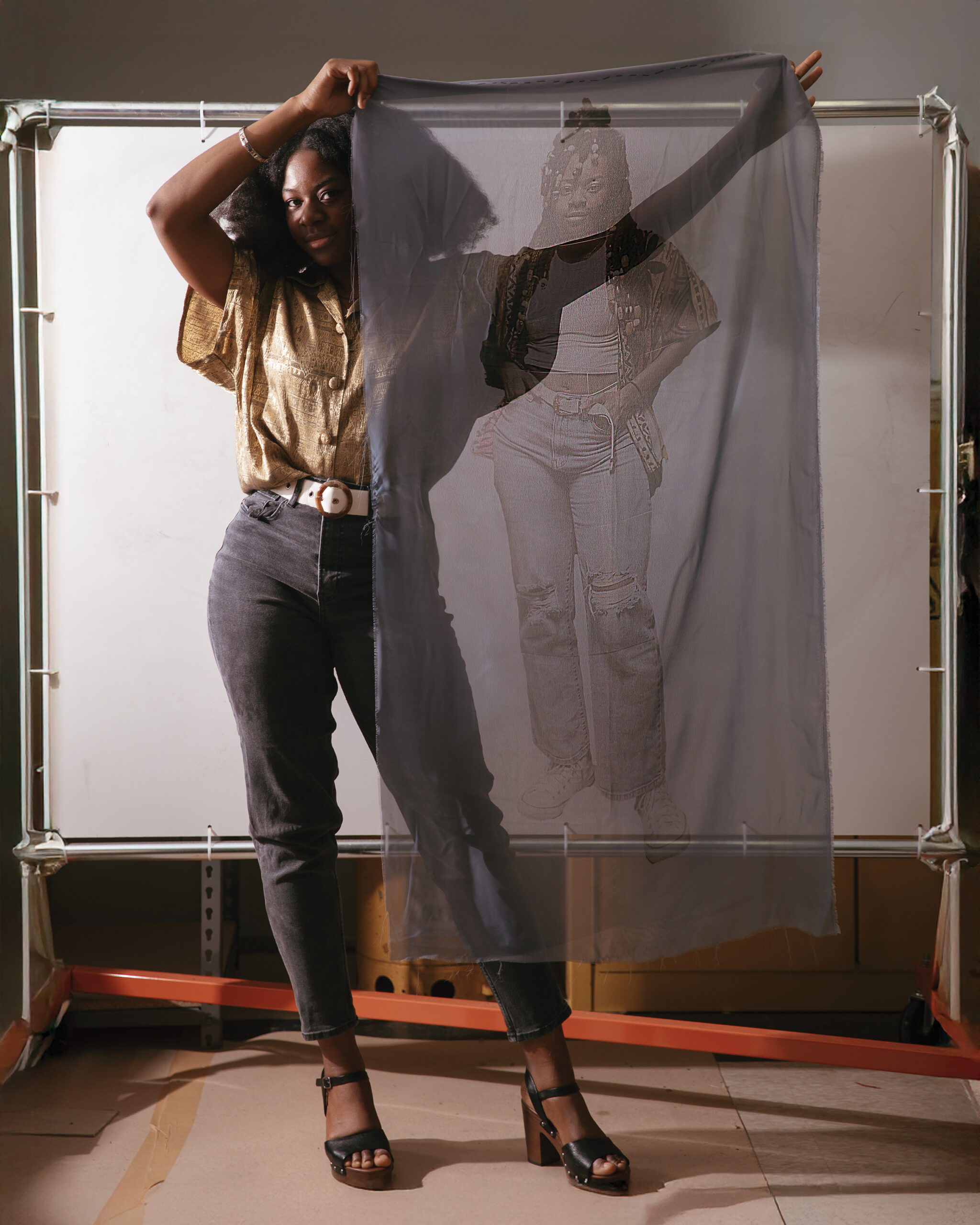
“You’re doing your own character development over and over,” she says. “Once you build it back up, you find one little bit that’s like, ‘Actually, that doesn’t feel authentic. Gotta dismantle it. Start all over.’ The work itself helps me deal with how I feel like I don’t fit into spaces. It’s also making me remove the negative self-talk and remind myself that it’s a great thing to be able to mesh in with the crowd sometimes.”
Using her work to advocate for herself and for others with similar experiences is relatively new for Essien, something she only began doing seriously when she started graduate school in 2023. Before that, she made art because she was good at it, and to meet the assignment deadlines and criteria given by her undergraduate art professors at the University of Louisiana Monroe. But, she says, in her defense, she didn’t enroll in the art program to spread any sort of message.
Essien enrolled in the art program to give herself a chance to pursue a path that made her happy. She hadn’t been doing that prior. Despite being an artistically inclined child, influenced by her artist dad and teacher mom’s creativity, Essien had no plans to become a professional artist.
Instead, she envisioned herself as a pharmacist, and when she began her undergraduate career, she declared pre-pharmacy as her major. Eventually, Essien realized that the pharmacy track wasn’t a path she wanted to continue walking and decided to change course. She switched her major from pre-pharmacy to art, and after that, she says, “Everything, my whole mentality and outlook, flipped around.”
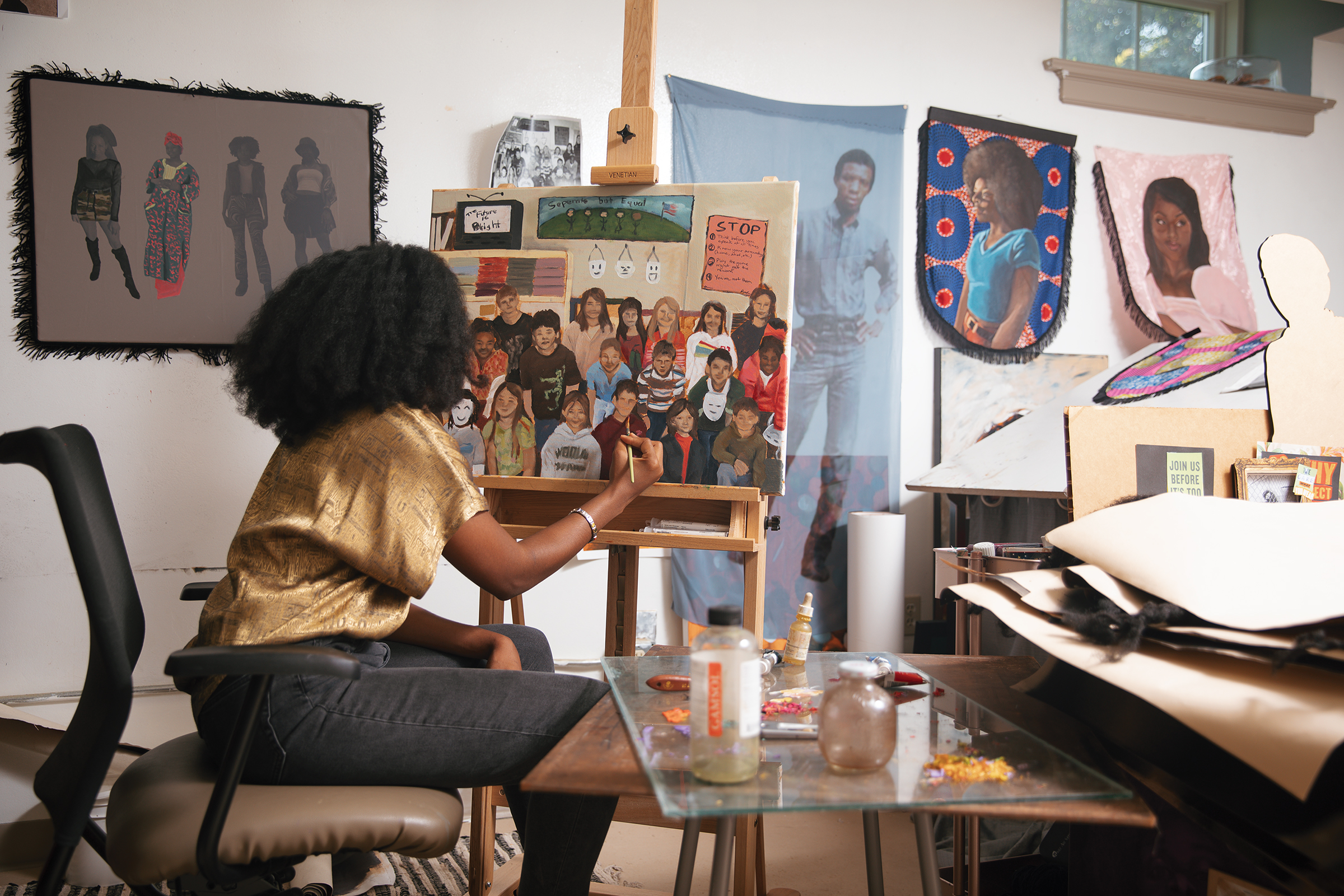
Essien says studying art at ULM improved her mental health immensely. She was hungry to learn more about art. It also didn’t hurt that she was good at it, she says, adding with a laugh, “[Let’s just say] I can draw more than a stick figure, so I felt like I could do well.”
“Undergrad me was different from me right now,” she explains. “Undergrad me was making work for the assignment. Plus, having the occasional out-of-the-blue commission here and there made me say, ‘OK, some people do see some value in the skills I can offer.’”
Back then, she busied herself honing the skills she already had and learning new ones — “I learned a bit of ceramics, and I’m not going back; I’m not great at that,” she quips, laughing — to earn a good grade or a satisfied customer. Now, though, she’s working on tailoring her work less toward what she thinks someone would want to buy and more toward the message she wants to convey.
This mindset has seeped from Essien’s fine art endeavors and into her screen printing business, Make It Deeliberate. The business and her shirts, printed with quirky and creative original designs, are probably what Essien is most known for, and she likes it that way. As much as she enjoys working in other mediums, she’s more interested in printmaking — screen printing, embossing, and the like — and she’s eager to find ways to bring cultural identity into those mediums.
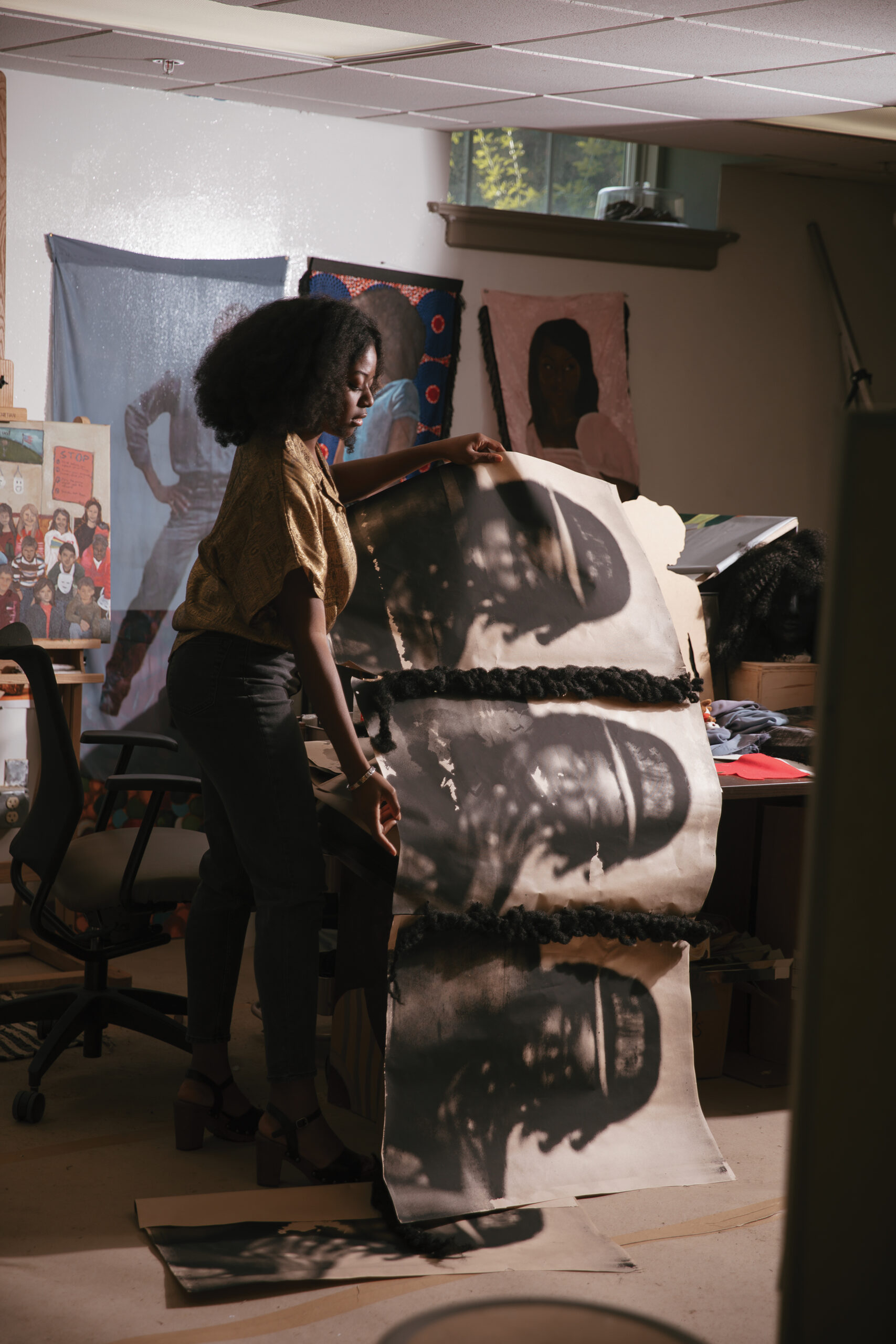
In a way, she says, she’s already doing it.
“Clothing and fashion have always been big interests of mine, and those tie into my [fine art] work because how you present yourself to the world and how the world sees you can come from what you wear,” Essien says before explaining that her clothing choices have often been her key to blending into an environment. “I could change my outward appearance and then, technically, I’m there.”
Essien was still an undergraduate student when she started Make It Deeliberate. She had learned screen printing in one of her classes at ULM, and when The Good Daze owner, Hartley Waldrop Arendsen, hosted a vendor market, Essien decided to try selling her work.
Much like the rest of what she was making at the time, Essien’s screen-printed designs were designed with someone else in mind. That approach worked for her, and her assumptions on what a customer might want to buy were spot-on enough to earn her a spot as one of The Good Daze’s artist vendors, collaborations with the Downtown Gallery Crawl, and general success in business. But now, she’s ready to bring more of her own identity into her screen-printed creations.
“It took me a while to stop thinking from a client’s perspective and ask myself what I would wear,” she admits. “You’re also selling your personality to an extent. If they know I’m proud of it and I say, ‘This is me,’ they can say, ‘A bit of that is me, too.’ I think I’m still working on that.”