



Bayou Icon | PHILIP TRAHAN
ARTICLE BY GEORGIANN POTTS
PHOTOGRAPHY BY KELLY MOORE CLARK
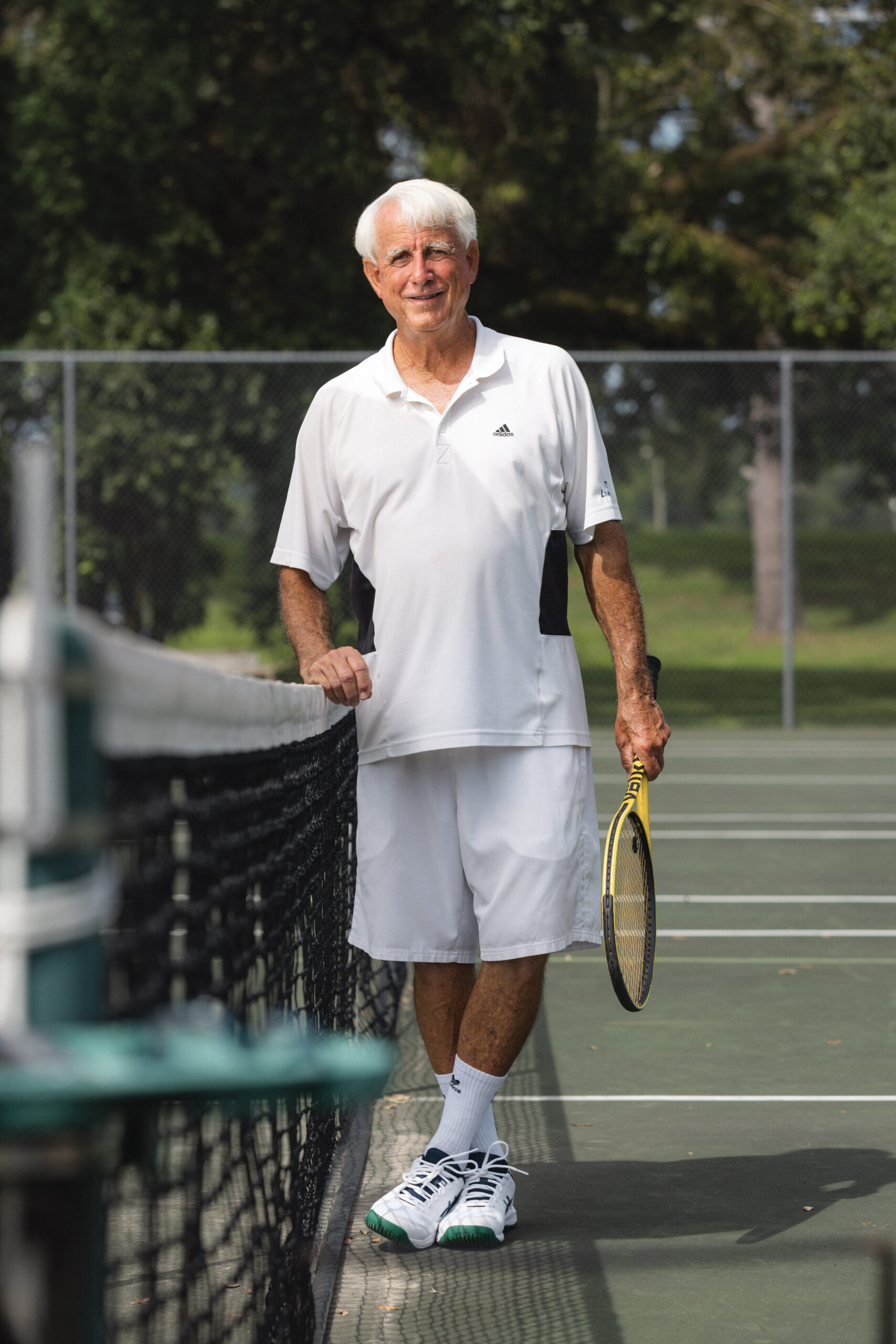
Many people in our area know Philip Trahan. He has been a part of our community since fall 1970 when he enrolled at Northeast Louisiana University (now ULM) on a tennis scholarship. Phil was recruited by Dr. Del Vines (an avid tennis player himself who was at that time Dean of the Business School and later became President). An outstanding collegiate tennis player, Phil played in the NCAA Division One Championship in Los Angeles marking the first time that NLU had ever participated. Phil coached tennis throughout his college career, but set it mostly aside while he developed a successful career in the mortgage business. When he retired from that career in 2007, Phil happily returned to coaching tennis – his first love. He has always been an advocate for volunteerism and is an active volunteer for many non-profits including CASA, St. Vincent de Paul, NELA Food Bank, and Mercy Chefs. In addition, he works with “Serve and Return,” a 501 (c)3 that offers free tennis clinics and scholarships. Because of his love for tennis that has touched so many lives, and because of his dedication to helping others in our region, Philip Trahan is our August BayouIcon.
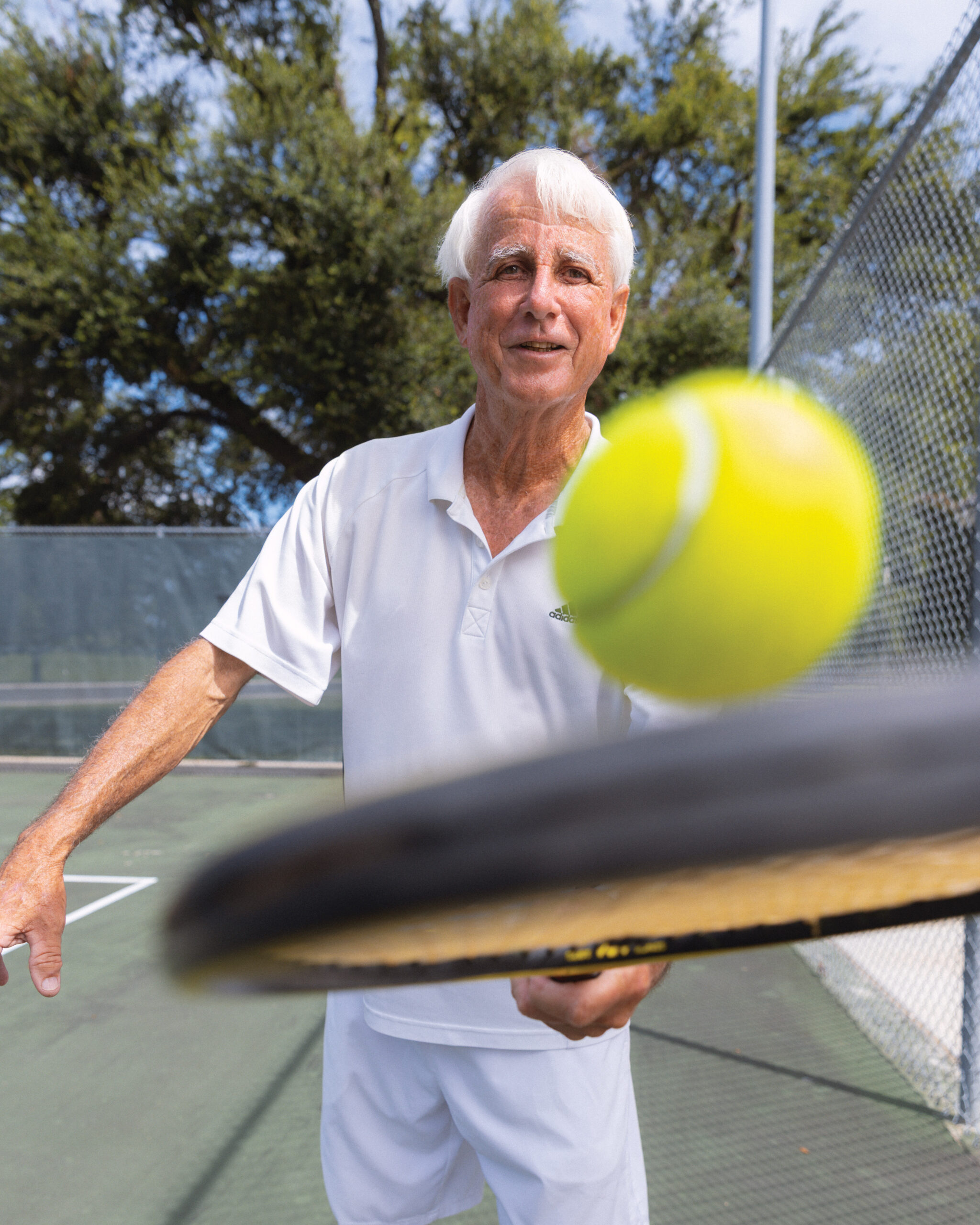
LIFE FOR PHILIP TRAHAN HAS ALWAYS included tennis. He loved playing it from childhood and still does today. Along the way Phil has also coached tennis to countless people who wanted to improve their game. But there is more to Phil’s life than a game that became a career. He also enjoyed a very successful 25-year career in the mortgage business. A chance meeting with Ralph and Nat Troy while he was at NLU and teaching tennis at Bayou DeSiard Country Club led to that career opportunity. Once he retired from the mortgage business, Phil returned to coaching tennis which he still does today. There is no question that tennis has been a life-long passion for him!
BECOMING A TRAHAN
Phil’s parents met during war time in England. Glady Joseph Trahan was serving in the United States Army in England when he met Mary Margaret Stritch, a young lady from Croydon, a suburb of London. A teenager, Mary Margaret endured the Nazi bombs falling during the blitz of London.
The two fell in love and married on June 29, 1945, at St Chad’s Catholic Church in London. Glady was discharged August 30, 1945. He was born in 1918 in Rayne, Louisiana, but lived his entire life in Crowley (only 7 miles away). Mary Margaret was 5 years younger. There was a bit of a language “difference,” according to Phil. He says that his dad spoke “Cajun Country” until he entered first grade and learned to speak “American English.” His mother spoke the “Queen’s English.”
Although there were some early adjustments, the two happily established their home in Crowley. Glady returned to the printing business, and Mary Margaret ran their home. As the years passed, they welcomed nine children.
All of their children grew up to be successful. Phil was the first born (1952). Marian was next (1954) and works in the headquarters of a large convenience store chain. Melanie (1956) is a farmer’s wife; John (1957) is a retired district judge; Peter (1959) was a chemical engineer who died in 2008 from lung cancer; Patrick (1960) is a retired banker; Mary (1962) is a retired assisted living/nursing home administrator; Thomas (1963) is a banker; and Laura (1968) is a registered nurse.
CHILDHOOD MEMORIES
Phil remembers his childhood as a happy time filled with family fun. The Trahan’s only moved once from their original home. “We moved one time, buying the house next door because we outgrew ours!” Phil says.
His paternal grandparents all lived in Crowley as did all of his Louisiana aunts, uncles, and cousins. Family holidays always centered on family activities that included eating barbeque enjoyed with the “specialties” brought by aunts and uncles.
Phil went to St. Michael Elementary and Junior High School, and graduated from Notre Dame High School. He enjoyed the speech/debate classes. “I liked speech/debate because that helped me to think logically,” Phil explains. “I traveled to Chicago and Washington DC for tournaments.” Phil’s specialty was extemporaneous speaking – a talent that he admits to still using on occasion as an excuse for failing to properly prepare for something.
While in school, Phil played tennis and basketball. Basketball was actually his favorite sport but didn’t provide a scholarship opportunity. Tennis did. John Daily, his basketball coach, was one of his favorite teachers during high school. “He was a steady coach who taught the game instead of just focusing on wins,” Phil says. Phil was strong enough at basketball that he made the All-District team his last two years.
Phil also played baseball through Little League. He played pitcher and would give his coach a list of the tennis tournaments he needed to go to. The coach would make sure that Phil didn’t pitch on those days so it worked out.
Phil’s family lived across the street from a park. When Phil was six years old, Crowley built two tennis courts there. He watched the construction, tagging along behind his dad and the neighborhood men. The group decided to try playing tennis. Phil became interested in the game, too, so his dad started working with him. Before long, Glady shared his new passion with his family, friends, students, basically anyone of any age who wanted to learn. Today Crowley has The Glady Trahan Tennis Centre, a 6-court facility that is a fitting tribute to the work promoting and playing tennis that Glady did. Because of his dad’s influence, Phil says that “. . . everyone in the family plays tennis, and some are pretty serious.”
Also when Phil was six, the family traveled to England to meet and visit with his maternal English and Irish family. Phil remembers the fun of crossing the Atlantic Ocean on a French ocean liner. “During that trip I teamed up with another kid to solve the mystery of who had stolen the silverware from the restaurant,” Phil says.
There were other childhood adventures, of course. When he was ten, Phil and a friend burned down an empty lot near his home. It happened when the two were trying to smoke cigarettes. “My friend insisted that since he had gotten the matches from his house, I was obligated to sneak Mom’s cigarettes from the kitchen while both of our moms were enjoying a cup of tea,” Phil says.
Phil says that his dad was his primary mentor when he was growing up. Glady worked hard and sent all nine children to Catholic school. A second mentor was former Senator John Breaux. “He was very helpful to me. He was 8 years older, a good tennis player, and owned a Corvette that along with the Greyhound bus line ferried me to tennis tournaments and practices,” Phil remembers.
MOVING UP NORTH
When Phil was in high school, he wanted to be a journalist. However, preference testing indicated that he should be a shoe salesman. When it came time to enroll in college (to NLU on a tennis scholarship), he selected General Business for his major. “I had no idea what I wanted to be; hence the nonspecific major in General Business,” Phil explains. He, along with many others, had been recruited by Dr. Del Vines, then Dean of the Business School. Vines was Phil’s primary mentor during his college years even though Phil never took a class taught by him.
While an undergraduate, Phil especially enjoyed several classes. Psychology 201 was a favorite. “I was interested in the subject and Maslow’s Hierarchy of Needs really made sense to me,” Phil recalls.Andrew Maslow (1908 – 1970 was a pioneering American psychologist and a founder of humanistic psychology. Maslow’s Hierarchy is a motivational theory in psychology that identifies 5 fundamental human needs, physiological, safety, love and belongingness, esteem, and self-actualization, that people must satisfy before they can reach their potential. A second favorite class was Dr. Mike Dolecheck’s Statistics class. He says that Dr. Dolecheck made the class fun through his energy and pleasant manner. “Going to class was fun and I learned that if you get heads 99 times in a row, the next flip will still be 50/50,” Phil explains. “That was the depth of my understanding of statistics. I didn’t do all that well, but I enjoyed it.”
Tennis took up most of Phil’s time, although he made time to play some intramural basketball. That favorite high school sport still attracted his attention when possible. The highlight of his collegiate tennis career came in 1974 when he and his NLU teammates, Terry Moor, Mark Sanders, and David Methvin, played in the NCAA Division One Championships in Los Angeles. This was the first time that NLU players had reached that level.
Phil made it into the third round at the Championships, but lost a close 3-set match to the number one player from Michigan. That fellow was also the tournament’s overall second seed. “The next day my doubles partner Terry Moor defeated the number one seed who was UCLA’s top player,” Phil remembers. “So if I had just been able to pull out my match, little NLU would have taken out the top two seeds! I’m still haunted by that near miss.”
Phil loved playing on the NLU tennis team. “My sister Marian and I were the only ones representing our high school so NLU was the first real team I had played on,” Phil says. “I played better playing on a team knowing others were depending on me.”
For the fall of 1974, Phil was accepted to the Louisiana State University Law School. He took only 12 hours at NLU that spring semester and had his law school hours help complete his business degree. Phil admits that he chose law school because at the time it was believed that if you got a law degree you could pursue lots of careers. After his first year studying the law, Phil left those studies. “I realized that I am not cut out for that much reading, so I returned to NLU and coached the men’s tennis team while I began the MBA program there,” Phil explains. “I received my BBA in spring 1975, and the MBA in 1979.”
As soon as he enrolled at NLU, Phil began teaching lessons at Bayou DeSaird Country Club and did that his entire college career. It was while he was attending NLU and teaching tennis lessons at BDCC that Phil met Ralph and Nat Troy. That was during the 1970’s when everyone wanted to play tennis. The sport was very popular, especially among the “golf widows” who were looking for an outlet while their men played golf and hung out at the 19th hole.
During those years, Phil remembers one of his NLU teammates getting very angry and slinging his racket over the fence. It lodged in a tree, and their coach had to climb that tree to retrieve it. He also remembers with a smile going to cocktail parties and having people say that they’d never seen him in his clothes.
CORPORATE LIFE INTERLUDE
Phil’s first job outside of tennis was working at Troy and Nichols Mortgage. He worked there and for the companies that developed after the original business sold in 1984. In 1996 Phil and others formed T&N Mortgage which operated until 1999 when they sold it to North American Mortgage.
When that company sold, Phil consulted a career advisor to help decide what to do next. The first question the advisor asked was how Phil had managed to survive 25 years in the mortgage business based on his performance on a battery of tests. Phil remembers that during one of the timed tests, the advisor stopped the test and suggested that he just move on to the next. That wasn’t encouraging.
Following his time in the mortgage business, Phil became a real estate investor in residential rentals. In 2007, he returned to his first love, tennis. “Tennis has been the most rewarding because I’m better at that than mortgage or real estate,” Phil says. “As a coach you are in a position to influence others in life, not just sports.”
A LOVE MATCH
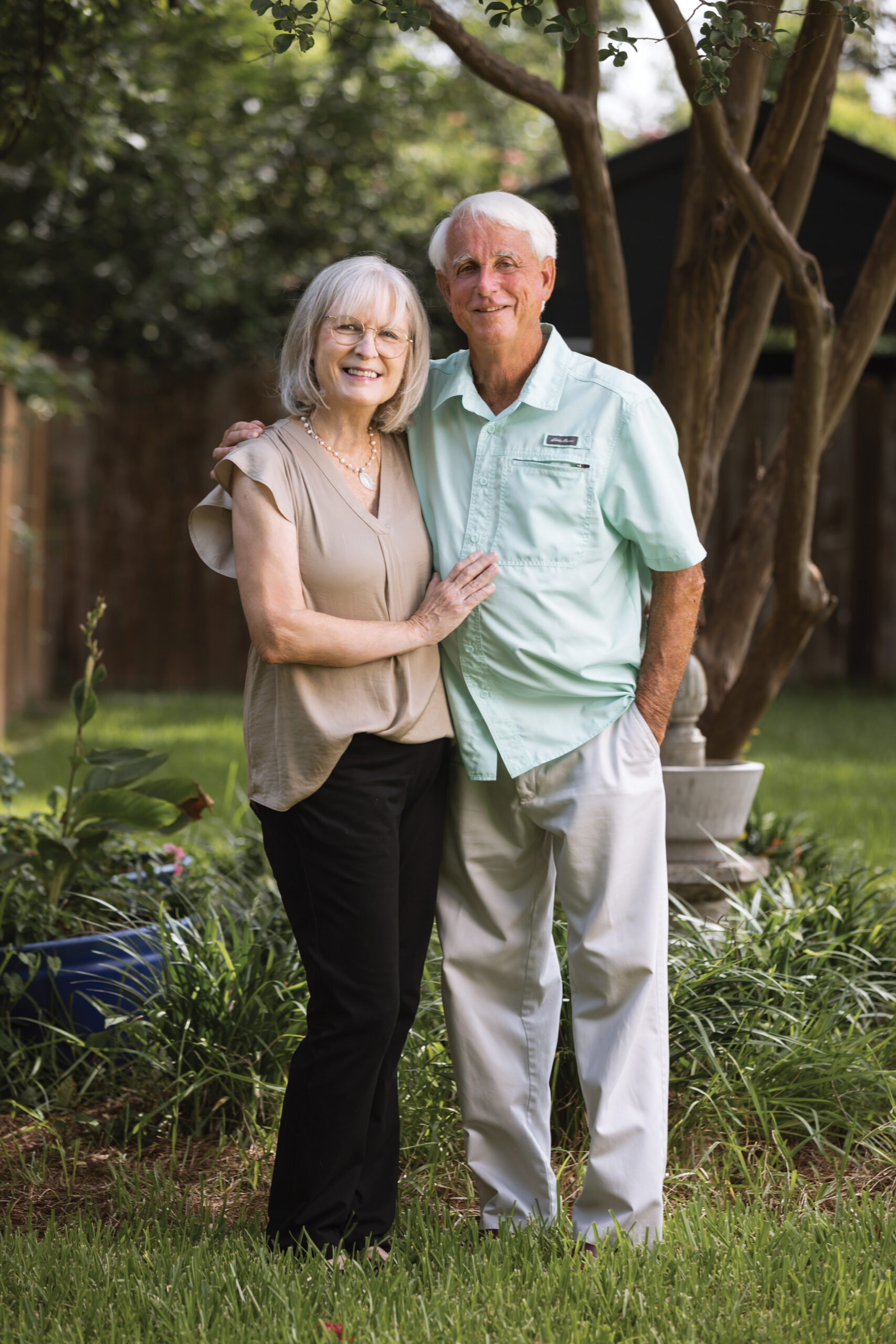
The year Phil was a senior at NLU, he met a member of NLU’s first women’s tennis team, Karen Zimmerman. Today the two have been married 50 years, a golden union, indeed.
Phil describes the two under the category of “Opposites Attract.” He describes himself as spontaneous and impulsive. Karen, according to Phil, is organized and disciplined. He says she is an excellent player with an additional sport – karate. “Karen earned the Black Belt when she was 17,” Phil says with pride. “So we don’t fight much.” Today Karen is an accomplished glass artist.
The couple had three children, two boys and a girl. Their eldest child, Andy, passed away after a courageous 7 ½ year battle with lung cancer. Had he lived, Andy would be 47. He played tennis and basketball, graduated from NLU, worked in banking, and then began his own business. That business, Trahan Solutions, is managed by his widow, Leslie Marsala Trahan. Their second child, Joey, is 45 and lives in Charleston, South Carolina, with his wife Sarah Koranda Trahan. He played tennis, basketball, and baseball and graduated from NLU before earning an MBA from The Citadel. He is a data engineer. The youngest, Jennifer, is 40 and married to Victor Loraso. She is an elementary school Counselor in Madisonville, Louisiana, and operates a private counseling business. Jennifer earned a bachelors and masters from LSU. While at LSU, she was a CASA volunteer. She and Joey are both pretty strong tennis players, according to proud father Phil.
LOOKING FORWARD, AS ALWAYS
Travel is an activity that Phil would like to indulge in more. He loves New York City (“the noise and bustle”) and remembers one trip there when he was working in the mortgage business. The company attorney and Phil were going to NYC on business. Their flight out of Monroe was delayed and one passenger created what Phil calls a “spectacle” while everyone else remained composed until the plane finally departed. “That night we had been comped some Broadway show tickets,” Phil says. “When we took our seats, across the aisle there sits that same guy.”
Phil always enjoys going to New Orleans (another favorite city). There he especially enjoys listening to his favorite band, Tuba Skinny, a traditional jazz, blues, and ragtime street band. England and Ireland are also on his “someday” travel list. Revisiting his mother’s homeland would be special. Karen and Phil went in 1988 and then again in 1995 when they took their children
Phil finds coaching tennis easier than playing it. He just enjoys teaching, frankly, no matter the subject. ‘The best name I’ve ever been called is ‘Coach,’” he says. Among famous tennis players, the ones Phil wishes he could have met are Arthur Ashe and Althea Gibson who both broke the color barrier in tennis. “Arthur was the epitome of class during a time when tennis etiquette was waning,” Phil says.
Today his days are predictable, unless he has a “spontaneous” moment! He coaches tennis for three hours and then works in his yard. He will occasionally watch instruction videos posted by coaches he admires. “I get good ideas from them,” Phil admits.
Phil is also a dedicated community volunteer. Currently he is volunteering as an advocate for CASA and is on his second case. In the past he has run some fundraising tournaments for CASA called “Tennis Meets the Boogie Woogie.” The clever name came from entertainer Lindy Gravelle. “I hired her,” Phil explains. “She cut her teeth in Nashville and specialized in man-bash songs.” He also volunteers his time at Serve and Return, a Monroe-based organization founded and run by Tynea Hill. Phil volunteers at their free tennis clinics.
Legendary tennis champion Arthur Ashe once wrote, “Success is a journey, not a destination. The doing is often more important than the outcome.” In many ways, Philip Trahan’s success over a lifetime of tennis has been a journey. And with every tennis match and every tennis class, Philip Trahan’s journey continues.