



The Sound of Fear
by Guy Miller, Vice Chair Emeritus, Chennault Aviation and Military Museum
I’ve heard it said most people don’t remember anything that happens during the first few years of their lives. While this is generally true for me, I do have bits of memory from various times I spent in the house my grandparents owned before they sold it when I was four. One of these memories was some of my adult family being concerned about something with a funny name- Sputnik.
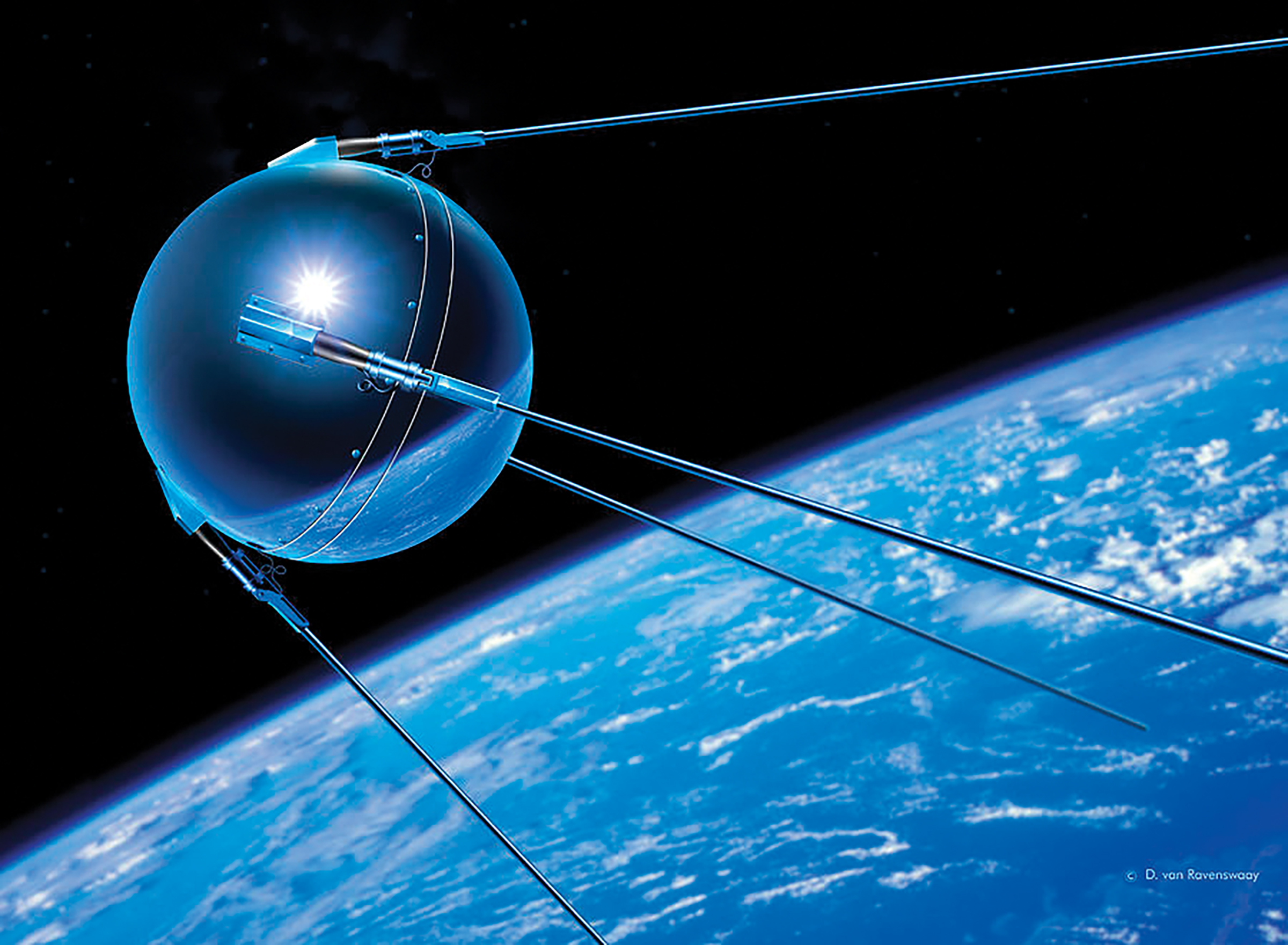
Sputnik 1 was the first artificial satellite launched into Earth orbit. It was launched the day before my second birthday- October 4, 1957. Sputnik was not launched by the United States. It was launched by Soviet Russia.
Sputnik 1 was not anything sophisticated; even for the time. The satellite (Sputnik actually means “satellite” in Russian) was a metal ball less than two feet in diameter with four equally spaced antennas pointing “backwards” and a little outwards from its middle. All Sputnik did was orbit and send a beeping signal for a little over three weeks. The beeping stopped on October 26th and after three months in orbit, Sputnik reentered the atmosphere on January 4, 1958 and burned up during descent.
Sputnik 1 did not do anything but beep but those beeps were heard by anyone with a short wave radio. The fact that people had a constant aural reminder of Soviet technological prowess concerned and even terrified many people in the Western countries; I guess including some in my adult family.
America had emerged from World War II believing it was the technological superpower in the world. Russia was a big bad bear but believed to be somewhat backwards in technology. The launch of Sputnik proved Russia had made a technological leap and was arguably ahead of America. With the world was wrapped up in the nuclear threat of the Cold War, to find out your “enemy” could launch something into orbit which we could not prevent, and which could potentially hold a bomb and fall onto American soil was scary indeed. Of course much of the hysteria was generated by the press which used the event to encourage fear and thereby increase their profits by creating a news-hungry population. The New York Times, for example, declared Sputnik I was a major global propaganda and prestige triumph for Russian communism. It sounds like things have not changed since then as far as some American “journalism” is concerned.
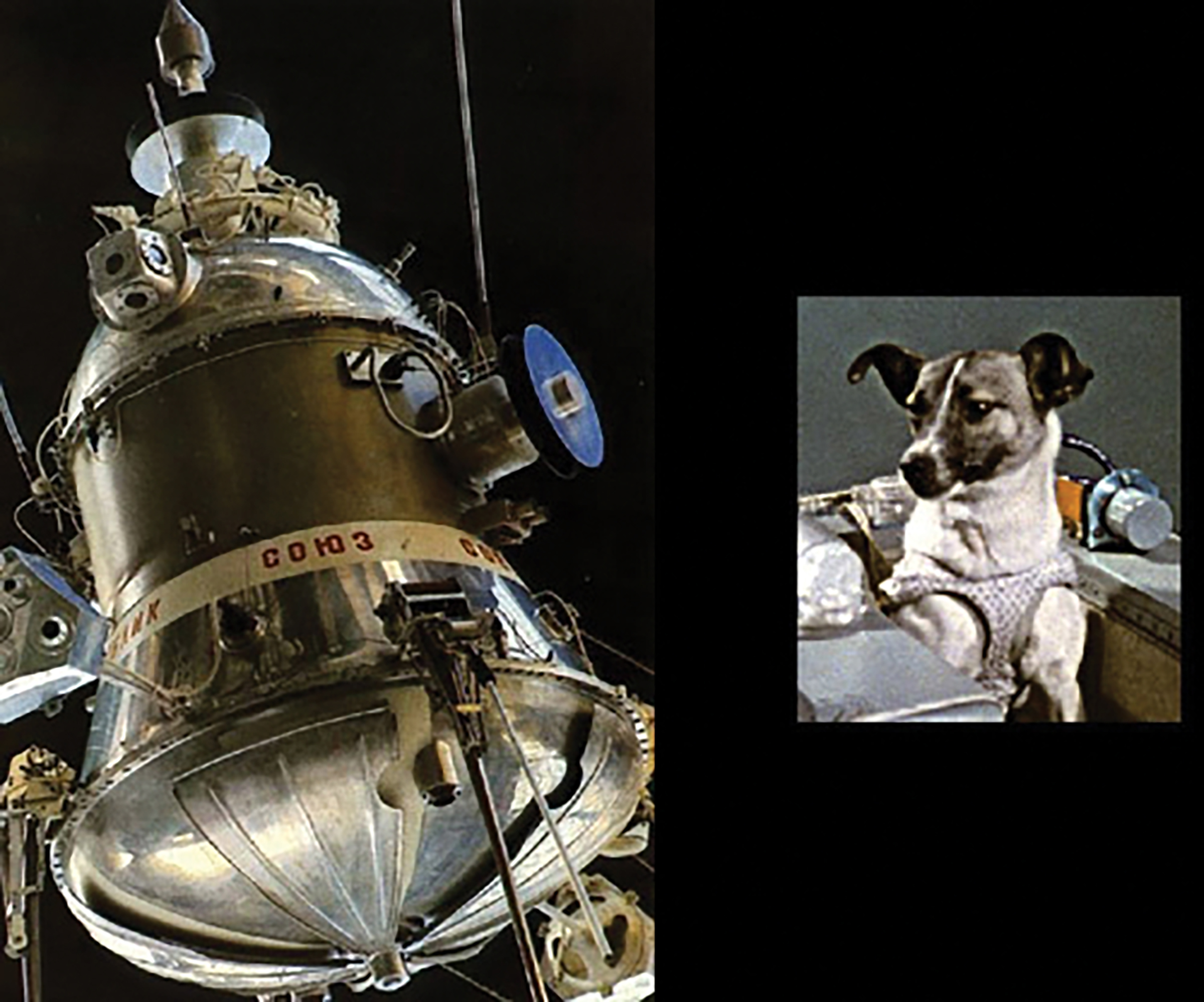
The Soviets quickly followed up with Sputnik 2 on November 3rd. The second Russian satellite was of a different design and included radio transmitters, a telemetry system, a programming unit, a regeneration and temperature-control system for the cabin, and scientific instruments. In a separate sealed cabin, a dog named Laika became the first terrestrial life form sent into space. The passenger cabin contained food for Laika and the dog was fitted with a waste collection bag.
Spoiler alert, Laika died in orbit but the Russians knew that would happen. In fact, if Laika had not died from overheating in the fourth orbit due to a thermal control system failure, the Soviet scientists had planned to euthanize Laika with poisoned food. Sputnik 2 remained in orbit until April, 1958.
The U.S. began launching its Explorer and Vanguard satellites in early 1958 but there were several failures within these series that did not help bolster the American public’s confidence. Sputnik did have a positive impact on America, however; one that lasts through today.
Through the CIA, President Eisenhower knew about Sputnik long before its launch. Five days after the launch of Sputnik 1, Eisenhower addressed the American people and when asked by a reporter about his concerns regarding the Soviet satellite, Eisenhower said, “Now, so far as the satellite itself is concerned, that does not raise my apprehensions, not one iota.” Eisenhower declared Sputnik was only a scientific achievement and not a military threat or change in world power.
Although the government professed a lack of concern regarding the Soviet launch, the American public did not have access to the intelligence on Soviet missile technology. Their ongoing reaction to the perceived threat of a Russian nuclear missile capability spurred Congress to action in what became known as the Space Race. The Advanced Research Projects Agency was established on February 7, 1958, (renamed the Defense Advanced Research Projects Agency, or DARPA, in 1972) with a mission to retake the lead in space and other military technology. On July 29, 1958, the National Aeronautics and Space Act established NASA as the American civil organization for its space program and research. The National Defense Education Act of September 2, 1958 increased government spending on scientific research and education. This Act also provided low-interest loans for college tuition to students majoring in mathematics and science.
American public perceptions began to shift quickly after these governmental actions and the initiation of successful U.S. satellite launches. After the October, 1957 launch of Sputnik, a poll conducted by the University of Michigan showed that 26% of those surveyed thought that Russian sciences and engineering were superior to those of the United States. A year later that figure had dropped to 10%.
Perhaps the most important consequence of America’s 1958 reactions to the Soviet Sputnik program was the decision by President Kennedy to land a man on the moon before the end of the 1960s. It is without question that America retook the lead in Space and has maintained it through the present day.