



“GOOD NIGHT, GOOD LUCK, A MERRY CHRISTMAS…”
by Guy Miller. Vice Chair Emeritus, Chennault Aviation and Military Museum
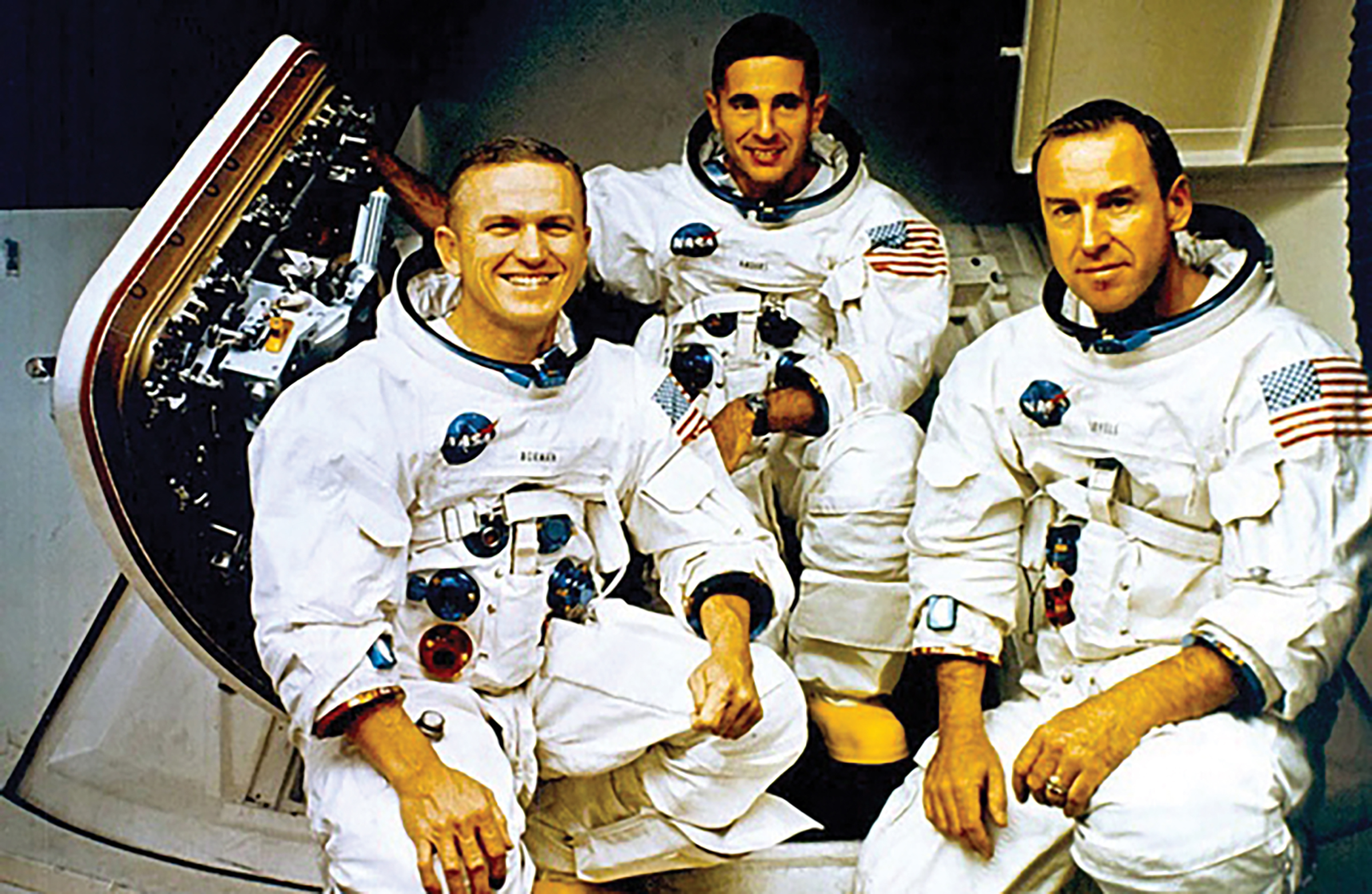
On December 25, 1968, Frank Borman, James Lovell, and William Anders set a record. They became the persons the farthest distance ever from their homes and families on Christmas Day- 234,474 statute miles (or 377,349 kilometers). Borman, Lovell and Anders were orbiting the moon.
Borman, Lovell, and Anders were the crew of Apollo 8. Jim Lovell had flown in space twice before on Gemini VII and Gemini XII. Frank Borman had been the commander of Gemini VII and that seniority made him chosen as commander for this mission over the more experienced Lovell. Lovell would be the first commander of a previous mission (Gemini XII) who flew as a non-commander. Anders had never flown before but had extensive training as a Lunar Module pilot.
Apollo 8 was the first manned spacecraft to leave low Earth orbit and head away from our planet. All prior American and Soviet spaceflight missions, including the first manned Apollo mission- Apollo 7, had remained in orbits around the Earth. Apollo 8 was also the third flight of a Saturn V rocket and the first crewed launch. Of all its “firsts” the most important for Apollo 8 was becoming the first human spaceflight to reach the Moon.
Apollo 8 was originally planned to be the second crewed Apollo Lunar Module (LM) and Command Module (CM) test flight. As such it was to be flown in an elliptical medium Earth orbit. Unfortunately, or fortunately for the crew, production of Apollo 8’s LM had fallen behind schedule. The delay and expected time to fix all problems endangered the NASA’s goal as established by President Kennedy in 1962 of a landing on the moon before the end of the decade. George Low, the Manager of the Apollo Spacecraft Program Office, proposed changing Apollo 8’s mission to sending a crewed CM to the Moon and entering lunar orbit before returning to Earth. In order that the spacecraft would have the correct weight and balance, Apollo 8 would carry a LM test article, essentially a non-functional full size model. Adjusting this and subsequent missions would allow the plan for lunar landing in mid-1969 to remain on schedule. After discussion of the changes among senior personnel at NASA, James E. Webb, the NASA administrator, authorized the mission.
Borman’s crew had to replace their planned Lunar Module Earth orbit training with translunar navigation training and also do so with two to three months’ less training and preparation time than originally planned. Apollo 8 would be the first crewed spacecraft to orbit more than one celestial body. The crew had to learn had two different sets of orbital parameters – one for Earth and one for the Moon- and a translunar injection maneuver. Moving from an orbital velocity of 25,567 feet per second to the injection velocity of 35,505 feet per second would set a record for the highest speed relative to Earth, that humans had ever traveled. Although less than the Earth’s escape velocity of 36,747 feet per second it would place Apollo 8 into an elongated elliptical Earth orbit that would come close enough to the Moon to be captured by the Moon’s gravity.
The crew wanted to name their spacecraft Columbiad which was the name of the giant cannon that launches a space vehicle in Jules Verne’s 1865 novel “From the Earth to the Moon.” NASA did not allow any name for this capsule but the later Apollo 11 CM was named Columbia partly for the same reason.
The basic design of the mission patch was developed by Jim Lovell. Lovell reportedly sketched it while riding in the back seat of a T-38 flying from California to Houston shortly after he learned Apollo 8 would be re-designated as a lunar-orbital mission. The mission patch was triangular like the profile shape of the Apollo CM. The red figure 8 looping around the Earth and Moon on the patch is both the mission number and the course of the circumlunar flight for the mission. On the bottom of the 8 are the names of the three astronauts.
Apollo 8 launched on December 21, 1968. It took the Apollo spacecraft 68 hours to travel the distance to the Moon. The crew then orbited the Moon ten times over the course of twenty hours. The three astronauts were the first humans to see and photograph the far side of the Moon and an Earthrise.
On Christmas Day, 1968 Apollo 8 performed the Trans Earth Injection (TEI) maneuver that put the spacecraft on a trajectory back to Earth from Lunar orbit. The Apollo 8 CM splashed down in the northern Pacific Ocean on December 27, 1968 – bringing its crew safely home. Apollo 8’s successful mission paved the way for the Apollo 9 and 10 missions; and, with Apollo 11 in July 1969, the fulfillment of President John F. Kennedy’s goal of landing a man on the Moon before the end of the decade.
While they were in lunar orbit, the crew made a Christmas Eve television broadcast. At the time, the broadcast was the most watched TV program in history. In their broadcast each astronaut read a section from the Biblical creation story from the Book of Genesis. Borman finished the broadcast by saying “And from the crew of Apollo 8, we close with good night, good luck, a Merry Christmas and God bless all of you—all of you on the good Earth.”