



In the Garden with Kerry Heafner: The Botany of Christmas
Christmas really is the most wonderful time of year because we can literally bring the outdoors indoors! For a fun activity this Christmas, take some time to wander out into our natural gardens and gather the makings for a homemade wreath. Start with a frame made from muscadine vines (Vitis rotundifolia) rolled into a ring as large or as small as you like. Use florist wire from a hobby shop to both hold the vines together and attach everything else to it. Take advantage of the abundance of evergreen trees and shrubs in the ArkLaMiss. Southern magnolia (Magnolia grandiflora) will not only have large, glossy foliage, but will also have the clusters of fruit, technically an aggregate of follicles, with the waxy red seeds still attached. Eastern red cedar (Juniperus virginiana) and arbor vitae (Thuja sp.) are two conifers that have foliage perfect for holiday decorations, and should have small, blue, berry-like female cones for added color. Loblolly and Virginia pine (Pinus taeda and P. virginiana, respectively) are scattered all over our area and can be used for their needles and cones. Female specimens of our native yaupon hollies (Ilex vomitoria) will have both glossy green foliage and red berries that you’ll have to compete with birds for. If you have an herb garden, sprigs of rosemary and sage will add both greenery and a different texture. Add some color to this green canvas with newly fallen leaves of deciduous trees like hickory for yellow, black gum or Bradford pear for scarlet, and southern sugar maple for yellows and oranges. A touch of blue can be added if you can find some leftover bunches of our native fox grape (Vitis labrusca) or certain species of cat briar (Smilax sp.) or even leftover branches of American beautyberry (Callicarpa americana) with clusters of tiny purple fruit still on them. Glue acorns, hickory nuts, and pecans into clusters and attach them at various places for something more 3-D. There’s no right or wrong so be creative! Then, when the holidays are over, hang your wreath in a strategic location in your landscape and see what wildlife enjoys it long after St. Nick is gone.
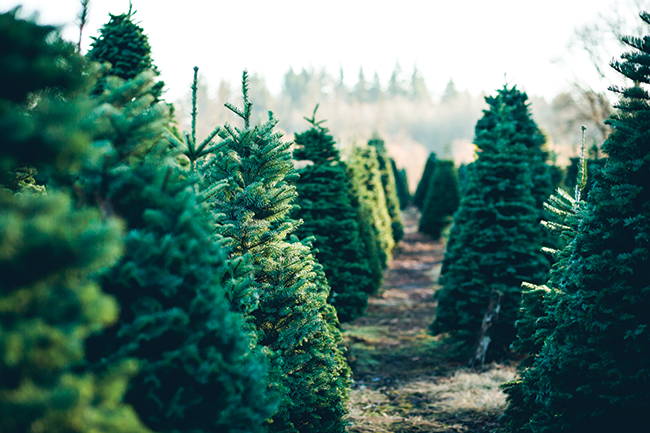
Are you using a real Christmas tree this year? If so, chances are it’s either Fraser fir, Noble fir, Scotch pine, or Arizona or Leyland cypress. Without doubt, Fraser fir (Abies faseri) is the most popular Christmas tree species used in the south and for good reason: the scent alone takes us back to a Christmas past. Natural populations of Fraser fir and red spruce (Picea rubens) dot the highest peaks, above 4,500 feet, of the Southern Appalachians. These relict populations were left after the last Pleistocene glaciers retreated some 20,000 years ago. Fraser firs are farmed in many Appalachian Mountain counties and trucked all over the country for Christmas.
When Christmas is over, what do you do with the live tree? It turns out used Christmas trees can greatly benefit wildlife. Here are two suggestions. If you live near a pond or lake, sink the tree just offshore with cement blocks. The tree will provide structure that fish and other aquatic wildlife will use for habitat. As many of our native game fish ambush their prey, the tree will provide them a good hiding place. Next spring, when the bite is hot, you’ll be glad you put your used Christmas tree to good use. If you don’t live on or near a body of water, then use your Christmas tree to attract birds. Treats made from suet, peanut butter, birdseed, and like material can be hidden among the branches for our feathered friends that overwinter in the area. As winter progresses into spring and if there are still any branches on the tree, good nesting habitat is available. Birds may simply enjoy perching in the branches on a winter day, anticipating spring bloom as much as we are.
Don’t forget to hang your mistletoe to stand under for that smooch from your Christmas sweetie! Mistletoe is a common name broadly applied to certain hemiparasitic members of the vascular plant family Santalaceae. “Hemiparasitic” means that mistletoe is photosynthetic, as evidenced by its green color caused by chlorophyll, but must also obtain water and nutrients from a host tree if infects using a specialized root called a haustorium. Eastern mistletoe (Phoradendron leucarpum) is the species native to our area and is visible now that its deciduous hardwood hosts such as ash, elms, maples, and oaks are leafless. The white berries are dispersed by birds but are toxic to us. Kissing under the mistletoe seems to have been cemented in Christmas tradition in Victorian-era England. Apparently, any woman who refused a kiss offered by a man was subject to bad luck. Supposedly, mistletoe also offered protection from witches and demons. Whatever your use for it during Christmas, be careful plucking it out of the tree it’s infecting. It often occurs on branches at heights that are unattainable by mere mortals.
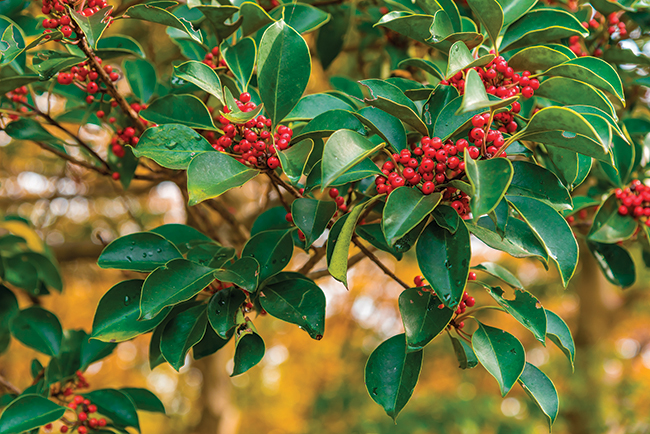
And, what epistle on Christmas botany would be complete without mention of hollies (Ilex sp.). Our landscapes are home to a list of native species and numerous cultivars, all of which have boughs perfect for decking halls with. Hollies are dioecious (die-EE-shus), meaning male flowers and female flowers occur on separate plants so there are literally male and female plants. Males produce pollen; females receive the pollen and produce the red berries we’re so familiar with. In addition to free Christmas décor, hollies are great pollinator plants. Honeybees heavily work holly flowers and birds consume the red berries in large quantities. They also use the branches for cover and nesting. Dwarf holly varieties are more disease-resistant alternatives to boxwoods and can be shaped to just about any form. A few native holly species are deciduous and can add an interesting texture to an otherwise homogenous landscape, especially if loaded with red berries at the time of leaf drop.
Finally, the NELA Master Gardeners will hold their tenth annual January gardening seminar on Saturday, January 18th, 2020, at the West Monroe Convention Center. The 2020 seminar theme is “Native Plants & Native Landscapes” and the speaker line up is impressive as usual. Keynote speaker will be Dr. Dwayne Estes of Austin Peay State University. Dr. Estes is Executive Director of the non-profit organization Southeastern Grasslands Initiative, or SGI. Known as the “Prairie Preacher,” Dwayne will be speaking about native grassland restoration projects his organization has been leading throughout the southern United States. We will also welcome legendary seed saver John Coykendall back to the ArkLaMiss. John will be on hand to sign copies of his newly published book, co-authored with Christina Melton of Louisiana Public Broadcasting. Be watching for January’s BayouLife for more information.
On a personal note, December 1st marks my fifth year as an extension agent for the LSU AgCenter. I can honestly say that I have not had a bad day at work in these fast five years. There are long days, there are hectic days, but there are no bad days. I would hope you could say the same about your job. Going to work every day is a privilege and I’m looking forward to many more years with the LSU AgCenter.
On behalf of the Northeast Louisiana Master Gardeners Association and the staff at the LSU AgCenter Ouachita Parish Extension Office, I wish you all a very Merry Christmas and a joyous, productive New Year!
For advice on how to make your garden thrive, go to the Ag Journal page at www.myarklamiss.com and submit your questions.I’ll answer them every Tuesday on Louisiana Living!